

THIS ISSUE
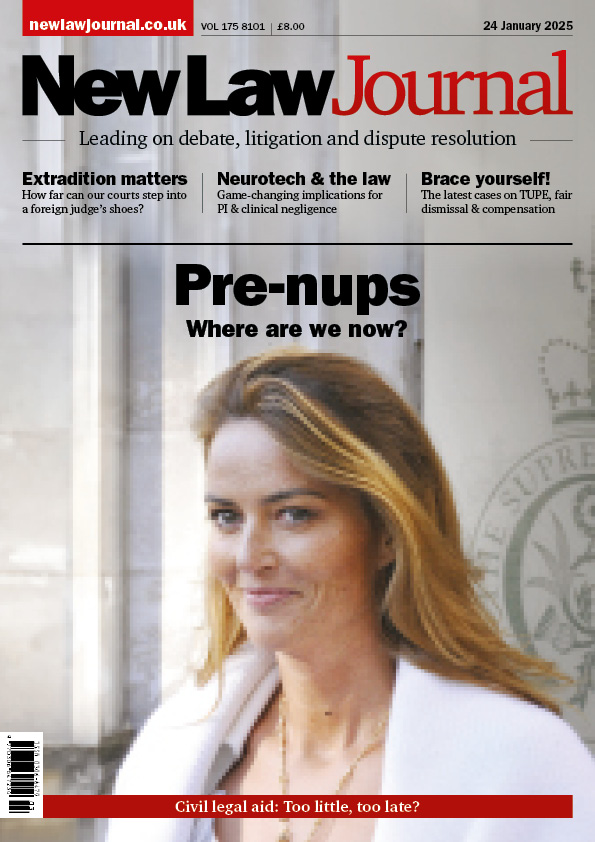

A test case on extradition has been granted permission to appeal to the Supreme Court. Writing in this week’s NLJ, George Hepburne Scott, barrister at Church Court Chambers, explains the issue—a lack of consensus among High Court judges about the extent to which they can take account of the prospect of early release overseas.
The validity of pre-nuptial agreements remains an inexact science. In this week’s NLJ, Mark Pawlowski, barrister and professor emeritus of property law, School of Law, University of Greenwich, examines recent caselaw, including cases involving foreign pre-nups where parties have subsequently sought divorce in the English courts.
Advances in implantable neurotechnologies could have a profound impact on rehabilitation, with consequent game-changing implications for personal injury and clinical negligence claims, Harry Lambert, barrister at Crown Office Chambers, explains in this week’s NLJ.
Two defendant states, Spain and Zimbabwe, who challenged the registration in English courts of arbitration awards made against them, came a cropper in the Court of Appeal last year. Writing in this week’s NLJ, international arbitration specialists Neil Newing, partner, and Pietro Grassi, senior associate, at Signature Litigation, explore the ruling in the combined case and its implications.
The Ministry of Justice’s latest review of civil justice has failed to inspire Roger Smith, former director of Justice. In his NLJ column this week, he reveals he read all seven reports over the new year and ‘did so with a heavy heart’.

Reading between the lines of the government’s latest review of the civil legal aid system, Roger Smith unearths the same old fundamental problems at its heart
To what extent are pre-nuptial agreements now recognised under English law? Mark Pawlowski weighs up the latest decisions
Ian Smith recommends a stiff drink & a towel around the head before plunging into the latest cases on TUPE, fair dismissal & enhanced compensation
To what extent can an English extradition court take account of the prospect of early release overseas? George Hepburne Scott calls for clarity
Coming advances in neurotechnology & their potential impact upon rehabilitation will be nothing short of transformational: Harry Lambert outlines their game-changing implications for personal injury & clinical negligence

MOVERS & SHAKERS

Bellevue Law—Lianne Craig
Workplace law firm expands commercial disputes team with senior consultant hire

EIP—Rob Barker
IP firm promotes patent attorney to partner

Muckle LLP—Ryan Butler
Banking and restructuring team bolstered by insolvency specialist
NEWS
The Supreme Court has delivered a decisive ruling on termination under the JCT Design & Build form. Writing in NLJ this week, Andrew Singer KC and Jonathan Ward, of Kings Chambers, analyse Providence Building Services v Hexagon Housing Association [2026] UKSC 1, which restores the first-instance decision and curbs contractors’ termination rights for repeated late payment
Secondments, disciplinary procedures and appeal chaos all feature in a quartet of recent rulings. Writing in NLJ this week, Ian Smith, barrister and emeritus professor of employment law at UEA, examines how established principles are being tested in modern disputes
The AI revolution is no longer a distant murmur—it’s at the client’s desk. Writing in NLJ this week, Peter Ambrose, CEO of The Partnership and Legalito, warns that the ‘AI chickens’ have ‘come home to roost’, transforming not just legal practice but the lawyer–client relationship itself
A High Court ruling involving the Longleat estate has exposed the fault line between modern family building and historic trust drafting. Writing in NLJ this week, Charlotte Coyle, director and family law expert at Freeths, examines Cator v Thynn [2026] EWHC 209 (Ch), where trustees sought approval to modernise trusts that retain pre-1970 definitions of ‘child’, ‘grandchild’ and ‘issue’
Fresh proposals to criminalise ‘nudification’ apps, prioritise cyberflashing and non-consensual intimate images, and even ban under-16s from social media have reignited debate over whether the Online Safety Act 2023 (OSA 2023) is fit for purpose. Writing in NLJ this week, Alexander Brown, head of technology, media and telecommunications, and Alexandra Webster, managing associate, Simmons & Simmons, caution against reactive law-making that could undermine the Act’s ‘risk-based and outcomes-focused’ design
Copyright © 2026 LexisNexis

