

THIS ISSUE


There’s good news for the family album, in this week’s Civil way, with the news that ‘those delightful post-adoption order photographs at court with child, family and judge’ may be allowed after all
Tucked within the Economic Crime and Corporate Transparency Act 2023 is a provision with ‘profound implications’ for victims of crime, Nicholas Yeo and Ryan Dowding, both barristers at 3 Raymond Building, write in this week’s NLJ
What does the coronial system actually achieve? Not much, according to some bereaved families who receive a ringside seat to the process of recommendations being made then ignored
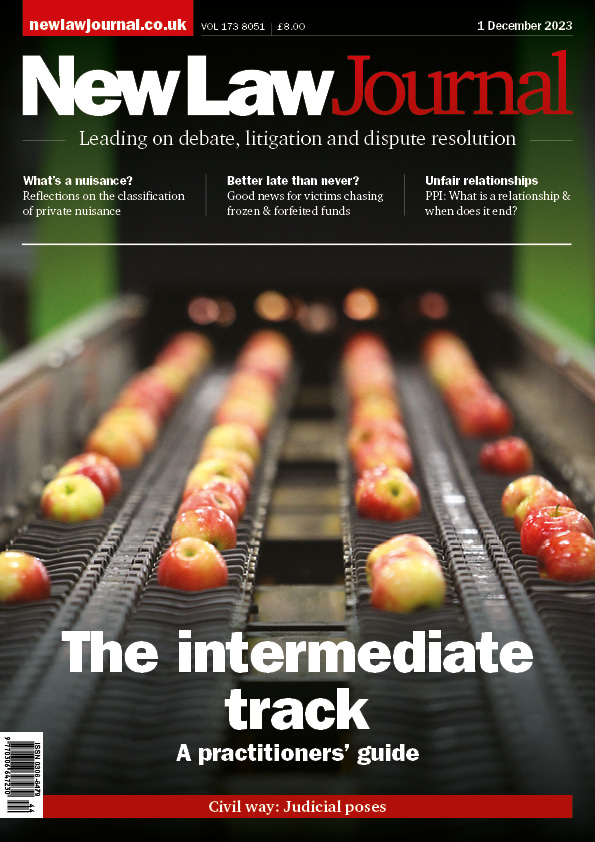
What do you know about the intermediate track (recently added to the small claims, fast and multi tracks)? In this week’s NLJ, Tricia Hemans and Daniel Black, both barristers at Falcon Chambers, provide a useful, in-depth and practical guide to the intermediate track—complete with handy checklist
The Ministry of Justice faces multi-million-pound cuts, according to the Office for Budget Responsibility’s (OBR) analysis of the Chancellor’s Autumn Statement
Local authorities have a duty to provide accommodation within a reasonable period of time rather than immediately, the Supreme Court has held in a unanimous landmark judgment
Lawyers have urged parliament to clear up the confusion over litigation funding in group action cases arising from PACCAR
The Sentencing Council has launched a consultation on revisions to the ‘Imposition of community and custodial sentences draft guideline’
The Lord Chancellor, Lady Chief Justice, Master of the Rolls, senior judiciary and representatives of the Ministry of Justice have set out their shared vision for greater digitisation within the civil justice system, including the online provision of pre-proceedings information and dispute resolution
The High Court has handed down a landmark ruling on artificial intelligence (AI), which will allow key aspects of AI to be patented in the UK for the first time


MOVERS & SHAKERS

Bellevue Law—Lianne Craig
Workplace law firm expands commercial disputes team with senior consultant hire

EIP—Rob Barker
IP firm promotes patent attorney to partner

Muckle LLP—Ryan Butler
Banking and restructuring team bolstered by insolvency specialist
NEWS
A High Court ruling involving the Longleat estate has exposed the fault line between modern family building and historic trust drafting. Writing in NLJ this week, Charlotte Coyle, director and family law expert at Freeths, examines Cator v Thynn [2026] EWHC 209 (Ch), where trustees sought approval to modernise trusts that retain pre-1970 definitions of ‘child’, ‘grandchild’ and ‘issue’
Fresh proposals to criminalise ‘nudification’ apps, prioritise cyberflashing and non-consensual intimate images, and even ban under-16s from social media have reignited debate over whether the Online Safety Act 2023 (OSA 2023) is fit for purpose. Writing in NLJ this week, Alexander Brown, head of technology, media and telecommunications, and Alexandra Webster, managing associate, Simmons & Simmons, caution against reactive law-making that could undermine the Act’s ‘risk-based and outcomes-focused’ design
Recent allegations surrounding Peter Mandelson and Andrew Mountbatten-Windsor have reignited scrutiny of the ancient common law offence of misconduct in public office. Writing in NLJ this week, Simon Parsons, teaching fellow at Bath Spa University, asks whether their conduct could clear a notoriously high legal hurdle
A landmark ruling has reshaped child clinical negligence claims. Writing in NLJ this week, Jodi Newton, head of birth and paediatric negligence at Osbornes Law, explains how the Supreme Court in CCC v Sheffield Teaching Hospitals NHS Foundation Trust [2026] UKSC 5 has overturned Croke v Wiseman, ending the long-standing bar on children recovering ‘lost years’ earnings
A Court of Appeal ruling has drawn a firm line under party autonomy in arbitration. Writing in NLJ this week, Masood Ahmed, associate professor at the University of Leicester, analyses Gluck v Endzweig [2026] EWCA Civ 145, where a clause allowing arbitrators to amend an award ‘at any time’ was held incompatible with the Arbitration Act 1996
Copyright © 2026 LexisNexis

