

THIS ISSUE

Professor Dominic Regan tackles the apparent myth that ‘individuals would overnight become adept at pursuing claims and would go it alone’ on small claims for road traffic injuries, in this week’s NLJ
Former District Judge Stephen Gold looks at the restrictions on domestic violence perpetrators cross-examining victims, in this week’s Civil Way. While the relevant sections of the Domestic Abuse Act 2021 are still not in force, ‘we remain under starter’s orders’
Hundreds of fully robed barristers gathered outside the Old Bailey with placards this week, as the Criminal Bar Association (CBA) strike action began
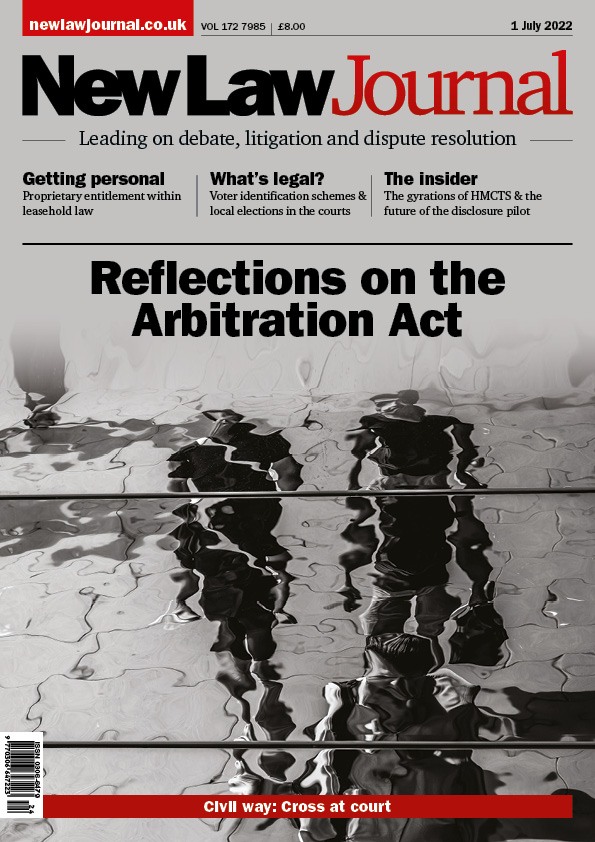
One quarter-century after the Arbitration Act 1996, what’s working and what requires change? In the second part of a series of articles, Ravi Aswani, of 36 Stone, and Valya Georgieva, of Penningtons Manches Cooper, look at the process of challenging an arbitration award on jurisdiction
The for-profit unregulated legal services sector may account for up to 9% of the market for individuals and 39% of the market for SMEs, researchers have found
More money could be returned to victims of crime, the Director of Public Prosecutions (DPP), Max Hill QC has told Peers
A National Deprivation of Liberty court (DoLs) is due to be launched next week, the President of the Family Division, Sir Andrew McFarlane has said
A team of experts from York, Cardiff and Lancaster universities has been appointed by the Solicitors Regulation Authority (SRA) to investigate the over-representation of solicitors from Black, Asian and minority ethnic backgrounds in reports made to it and in subsequent enforcement processes
The Law Commission has asked lawyers for their views on the risks and rewards of driverless cars
Lawyers have branded the government’s proposals for a Bill of Rights ‘Orwellian’ and an ‘erosion of accountability’

MOVERS & SHAKERS

Cripps—Radius Law
Commercial and technology practice boosted by team hire

Switalskis—Grimsby
Firm expands with new Grimsby office to serve North East Lincolnshire

Slater Heelis—Will Newman & Lucy Spilsbury
Property team boosted by two solicitor appointments
NEWS
The Supreme Court has delivered a decisive ruling on termination under the JCT Design & Build form. Writing in NLJ this week, Andrew Singer KC and Jonathan Ward, of Kings Chambers, analyse Providence Building Services v Hexagon Housing Association [2026] UKSC 1, which restores the first-instance decision and curbs contractors’ termination rights for repeated late payment
Secondments, disciplinary procedures and appeal chaos all feature in a quartet of recent rulings. Writing in NLJ this week, Ian Smith, barrister and emeritus professor of employment law at UEA, examines how established principles are being tested in modern disputes
The AI revolution is no longer a distant murmur—it’s at the client’s desk. Writing in NLJ this week, Peter Ambrose, CEO of The Partnership and Legalito, warns that the ‘AI chickens’ have ‘come home to roost’, transforming not just legal practice but the lawyer–client relationship itself
A High Court ruling involving the Longleat estate has exposed the fault line between modern family building and historic trust drafting. Writing in NLJ this week, Charlotte Coyle, director and family law expert at Freeths, examines Cator v Thynn [2026] EWHC 209 (Ch), where trustees sought approval to modernise trusts that retain pre-1970 definitions of ‘child’, ‘grandchild’ and ‘issue’
Fresh proposals to criminalise ‘nudification’ apps, prioritise cyberflashing and non-consensual intimate images, and even ban under-16s from social media have reignited debate over whether the Online Safety Act 2023 (OSA 2023) is fit for purpose. Writing in NLJ this week, Alexander Brown, head of technology, media and telecommunications, and Alexandra Webster, managing associate, Simmons & Simmons, caution against reactive law-making that could undermine the Act’s ‘risk-based and outcomes-focused’ design
Copyright © 2026 LexisNexis

