

THIS ISSUE


Lessons to learn from a High Court case involving both bigamy & intestacy, by Shivi Rajput
The landmark Supreme Court’s decision in Johnson v FirstRand Bank Ltd—along with Rukhadze v Recovery Partners—redefine fiduciary duties in commercial fraud. Writing in NLJ this week, Mary Young of Kingsley Napley analyses the implications of the rulings
Barristers Ben Keith of 5 St Andrew’s Hill and Rhys Davies of Temple Garden Chambers use the arrest of Simon Leviev—the so-called Tinder Swindler—to explore the realities of Interpol red notices, in this week's NLJ
Mazur v Charles Russell Speechlys [2025] has upended assumptions about who may conduct litigation, warn Kevin Latham and Fraser Barnstaple of Kings Chambers in this week's NLJ. But is it as catastrophic as first feared?
The Supreme Court’s judgment in the motor finance cases sheds light on the law on fiduciary duties, writes Mary Young
A landmark decision of the Upper Tribunal has widened the scope of cladding remediation: Bhavini Patel reports
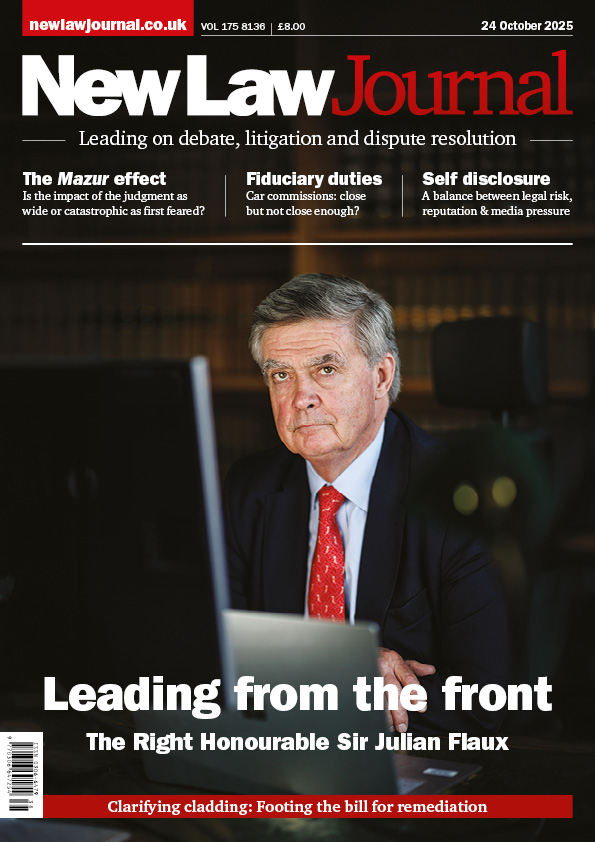
In a candid and reflective interview with NLJ, Sir Julian Flaux, Chancellor of the High Court, looks back on more than four decades in law—first as a leading light at the Commercial Bar and then as one of the senior judiciary’s most respected figures.
As he prepares to step down as Chancellor, he shares his insights on the challenges and triumphs of leading the Business and Property Courts through some of the most testing periods in recent memory, and on why morale, mentorship and balance matter most
Self-disclosure in a reputational crisis: Hanna Basha & Jamie Hurworth weigh up the benefits & pitfalls
In this week's NLJ, Bhavini Patel of Howard Kennedy LLP reports on Almacantar v De Valk [2025], a landmark Upper Tribunal ruling extending protection for leaseholders under the Building Safety Act 2022

MOVERS & SHAKERS

Cripps—Radius Law
Commercial and technology practice boosted by team hire

Switalskis—Grimsby
Firm expands with new Grimsby office to serve North East Lincolnshire

Slater Heelis—Will Newman & Lucy Spilsbury
Property team boosted by two solicitor appointments
NEWS
The Supreme Court has delivered a decisive ruling on termination under the JCT Design & Build form. Writing in NLJ this week, Andrew Singer KC and Jonathan Ward, of Kings Chambers, analyse Providence Building Services v Hexagon Housing Association [2026] UKSC 1, which restores the first-instance decision and curbs contractors’ termination rights for repeated late payment
Secondments, disciplinary procedures and appeal chaos all feature in a quartet of recent rulings. Writing in NLJ this week, Ian Smith, barrister and emeritus professor of employment law at UEA, examines how established principles are being tested in modern disputes
The AI revolution is no longer a distant murmur—it’s at the client’s desk. Writing in NLJ this week, Peter Ambrose, CEO of The Partnership and Legalito, warns that the ‘AI chickens’ have ‘come home to roost’, transforming not just legal practice but the lawyer–client relationship itself
A High Court ruling involving the Longleat estate has exposed the fault line between modern family building and historic trust drafting. Writing in NLJ this week, Charlotte Coyle, director and family law expert at Freeths, examines Cator v Thynn [2026] EWHC 209 (Ch), where trustees sought approval to modernise trusts that retain pre-1970 definitions of ‘child’, ‘grandchild’ and ‘issue’
Fresh proposals to criminalise ‘nudification’ apps, prioritise cyberflashing and non-consensual intimate images, and even ban under-16s from social media have reignited debate over whether the Online Safety Act 2023 (OSA 2023) is fit for purpose. Writing in NLJ this week, Alexander Brown, head of technology, media and telecommunications, and Alexandra Webster, managing associate, Simmons & Simmons, caution against reactive law-making that could undermine the Act’s ‘risk-based and outcomes-focused’ design
Copyright © 2026 LexisNexis

