

THIS ISSUE


Masood Ahmed & Osman Mohammed consider whether states must give express consent to waive their immunity
Chats on the boundary; owning up to AI in court; joint divorce popular: official; who needs a seal?!
Michael L Nash reflects on collisions, causes & consequences
The case of White v Alder may come to haunt future homeowners. In this week’s Civil Way column, former district judge Stephen Gold has some valuable advice for diligent conveyancing lawyers. Gold’s NLJ column also reports on updates to artificial intelligence (AI) guidance for judges. Could they use AI to help them draft judgments?
What protection is afforded to ‘without prejudice’ communications? This, and other conundrums are among the issues raised in recent personal injury caselaw. In this week’s NLJ, Vijay Ganapathy and Claire Spearpoint, both partners, Leigh Day, round up the latest important cases for practitioners
Jon Robins backs the calls of both Baroness Butler-Sloss & the Justice Committee for the watchdog’s leadership to resign
Neil Parpworth analyses Green v UK, in which the European Court of Human Rights upheld parliamentarians’ protection
Vijay Ganapathy & Claire Spearpoint discuss recent cases covering the assumption of responsibility, capacity, and the limits of without prejudice communications
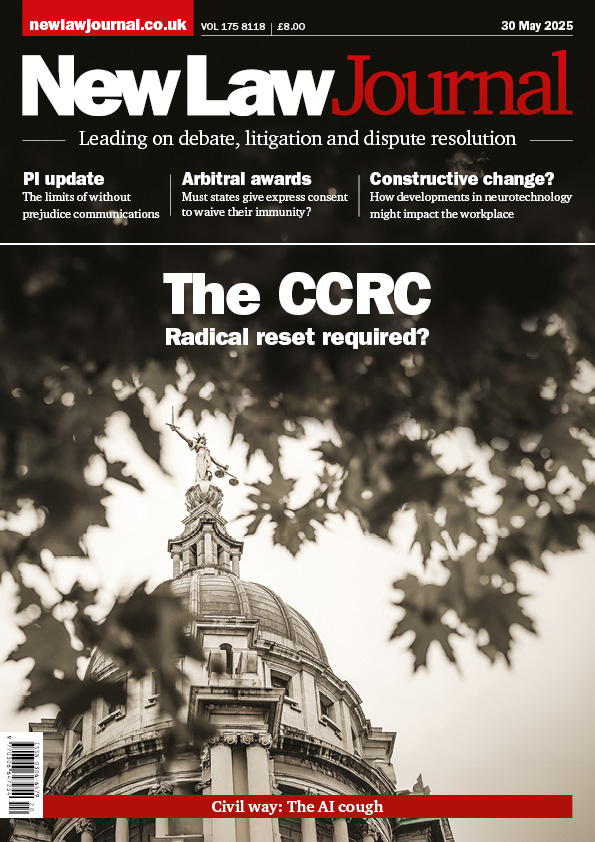
The astonishing failures at the Criminal Cases Review Commission (CCRC) have had a devastating impact on those it was set up to protect. The question now is what should be done? NLJ columnist Jon Robins highlights a radical suggestion by Baroness Elizabeth Butler-Sloss in a House of Lords debate on the subject this month
When advanced neurotechnology is used to monitor employees, what legal issues arise? In this week’s NLJ, Harry Lambert, Outer Temple Chambers, and Josh Neaman, Devereux Chambers, examine workplace rights at a new frontier, in the 8th part of a special NLJ series

MOVERS & SHAKERS

Bellevue Law—Lianne Craig
Workplace law firm expands commercial disputes team with senior consultant hire

EIP—Rob Barker
IP firm promotes patent attorney to partner

Muckle LLP—Ryan Butler
Banking and restructuring team bolstered by insolvency specialist
NEWS
A High Court ruling involving the Longleat estate has exposed the fault line between modern family building and historic trust drafting. Writing in NLJ this week, Charlotte Coyle, director and family law expert at Freeths, examines Cator v Thynn [2026] EWHC 209 (Ch), where trustees sought approval to modernise trusts that retain pre-1970 definitions of ‘child’, ‘grandchild’ and ‘issue’
Fresh proposals to criminalise ‘nudification’ apps, prioritise cyberflashing and non-consensual intimate images, and even ban under-16s from social media have reignited debate over whether the Online Safety Act 2023 (OSA 2023) is fit for purpose. Writing in NLJ this week, Alexander Brown, head of technology, media and telecommunications, and Alexandra Webster, managing associate, Simmons & Simmons, caution against reactive law-making that could undermine the Act’s ‘risk-based and outcomes-focused’ design
Recent allegations surrounding Peter Mandelson and Andrew Mountbatten-Windsor have reignited scrutiny of the ancient common law offence of misconduct in public office. Writing in NLJ this week, Simon Parsons, teaching fellow at Bath Spa University, asks whether their conduct could clear a notoriously high legal hurdle
A landmark ruling has reshaped child clinical negligence claims. Writing in NLJ this week, Jodi Newton, head of birth and paediatric negligence at Osbornes Law, explains how the Supreme Court in CCC v Sheffield Teaching Hospitals NHS Foundation Trust [2026] UKSC 5 has overturned Croke v Wiseman, ending the long-standing bar on children recovering ‘lost years’ earnings
A Court of Appeal ruling has drawn a firm line under party autonomy in arbitration. Writing in NLJ this week, Masood Ahmed, associate professor at the University of Leicester, analyses Gluck v Endzweig [2026] EWCA Civ 145, where a clause allowing arbitrators to amend an award ‘at any time’ was held incompatible with the Arbitration Act 1996
Copyright © 2026 LexisNexis

