

THIS ISSUE

Marie Law, Head of Toxicology at AlphaBiolabs, discusses the many benefits of oral fluid drug testing for child welfare and protection matters
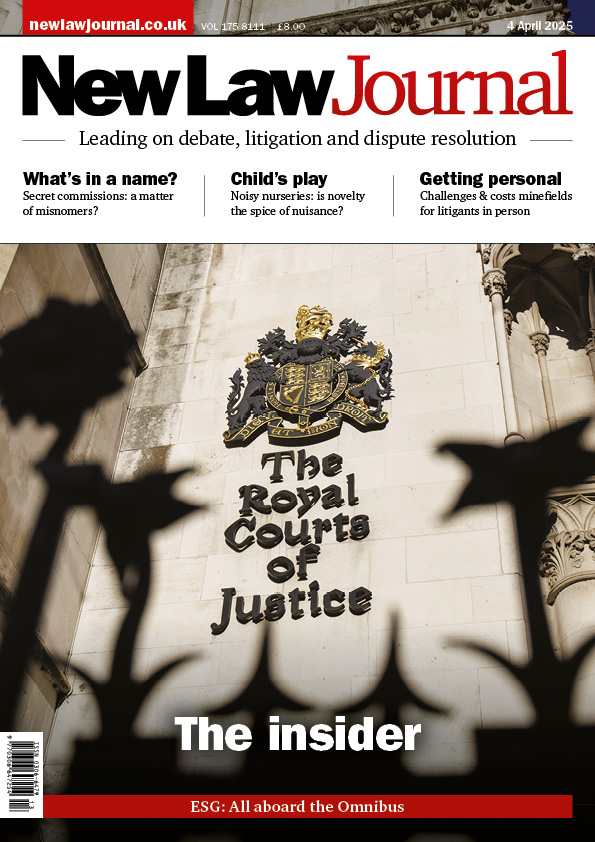
The Johnson v FirstRand Bank case on ‘secret’ commissions for motor finance is causing quite a stir, but should it have been brought at all? In this week’s NLJ, Fred Philpott, Gough Square Chambers, writes: ‘The whole premise of the case is false; there were no real “commissions”, let alone fiduciary relationships.’

Iris Karaman & Kate Chan discuss the practical impact of the EU’s proposed ‘Omnibus’ package
The complexities of costs proceedings can be a minefield for litigants in person. But the courts expect compliance with the rules, writes Julian Caddick
Imprisoning mothers has a devastating impact on more than the incarcerated. In this week’s NLJ, Rona Epstein explains the long-term effects on the mother’s children and urges the government to reconsider sentencing laws.
The Supreme Court case on motor finance commissions is based upon a simple economic falsity, argues Fred Philpott
Much favoured in finance contracts, asymmetric clauses have been confirmed as valid under EU law: Richard Marshall & Harriet Campbell consider the impact for contracting parties
As he takes the reins at the Association of Costs Lawyers, new chair David Bailey-Vella reflects on imposter syndrome, breaking down barriers & surprisingly unrelaxing hobbies
Tricia Hemans & Daniel Black consider common law nuisance & an interesting High Court decision on noise from a nursery
A recent case illustrates the financial risks facing litigants in person (LiPs) who fail to comply with the correct procedure on costs. Julian Caddick, council member of the Association of Costs Lawyers and a partner and head of costs at Thompsons Solicitors, explains the case in this week’s NLJ, and offers key takeaways for practitioners who find themselves opposite a LiP.

MOVERS & SHAKERS

Bellevue Law—Lianne Craig
Workplace law firm expands commercial disputes team with senior consultant hire

EIP—Rob Barker
IP firm promotes patent attorney to partner

Muckle LLP—Ryan Butler
Banking and restructuring team bolstered by insolvency specialist
NEWS
The Supreme Court has delivered a decisive ruling on termination under the JCT Design & Build form. Writing in NLJ this week, Andrew Singer KC and Jonathan Ward, of Kings Chambers, analyse Providence Building Services v Hexagon Housing Association [2026] UKSC 1, which restores the first-instance decision and curbs contractors’ termination rights for repeated late payment
Secondments, disciplinary procedures and appeal chaos all feature in a quartet of recent rulings. Writing in NLJ this week, Ian Smith, barrister and emeritus professor of employment law at UEA, examines how established principles are being tested in modern disputes
The AI revolution is no longer a distant murmur—it’s at the client’s desk. Writing in NLJ this week, Peter Ambrose, CEO of The Partnership and Legalito, warns that the ‘AI chickens’ have ‘come home to roost’, transforming not just legal practice but the lawyer–client relationship itself
A High Court ruling involving the Longleat estate has exposed the fault line between modern family building and historic trust drafting. Writing in NLJ this week, Charlotte Coyle, director and family law expert at Freeths, examines Cator v Thynn [2026] EWHC 209 (Ch), where trustees sought approval to modernise trusts that retain pre-1970 definitions of ‘child’, ‘grandchild’ and ‘issue’
Fresh proposals to criminalise ‘nudification’ apps, prioritise cyberflashing and non-consensual intimate images, and even ban under-16s from social media have reignited debate over whether the Online Safety Act 2023 (OSA 2023) is fit for purpose. Writing in NLJ this week, Alexander Brown, head of technology, media and telecommunications, and Alexandra Webster, managing associate, Simmons & Simmons, caution against reactive law-making that could undermine the Act’s ‘risk-based and outcomes-focused’ design
Copyright © 2026 LexisNexis

