

THIS ISSUE

A dispute between Ryanair and hundreds of its pilots could bring about a new route for trade union detriment claims, writes Charles Pigott, professional support lawyer, Mills & Reeve, in this week’s NLJ.
The decision to remove the three-year primary limitation period for claims arising from child sexual abuse has been welcomed by abuse survivors, Richard Scorer, head of abuse law and public inquiries at Slater & Gordon, writes in this week’s NLJ.
Bats in court? It can only be the latest report from The Insider, AKA NLJ columnist Professor Dominic Regan of City Law School.
Memory is fallible, so how should litigation lawyers be aware of this when preparing witness statements? Mary Young, partner, and Laurence Clarke, senior associate, in the dispute resolution team at Kingsley Napley, discuss the unreliability of memory and court procedure rules introduced nearly four years ago on record-keeping and preparation of witness statements.
The UK government has the power to review and potentially stop any business transactions that could threaten national security, courtesy of legislation that came into effect at the start of 2022. In this week’s NLJ, Ludovica Pizzetti, counsel, Arnold & Porter, looks at the operation to date of this legislation, the UK National Investment and Security Act 2021 (NSIA 2021).
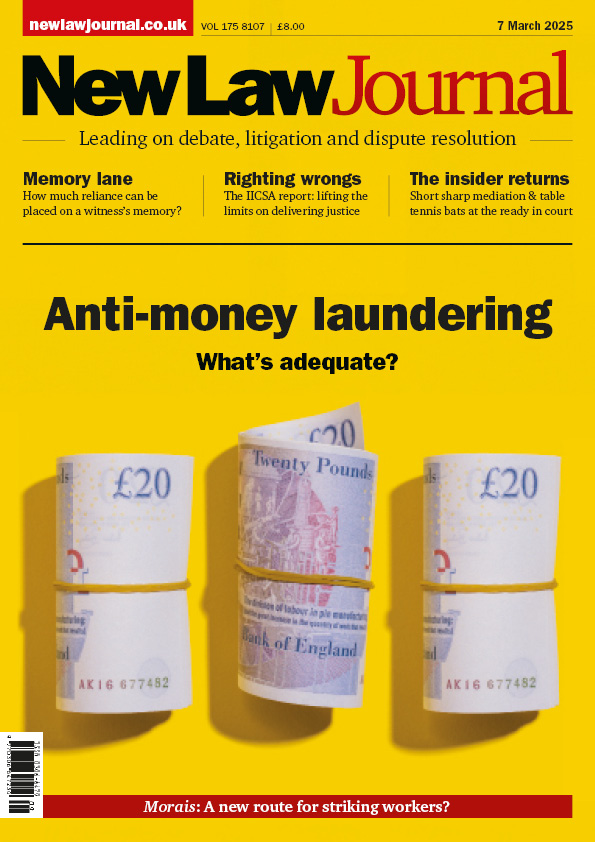
Is the anti-money laundering regime too vague? In this week’s NLJ, Jonathan Fisher KC, Red Lion Chambers, looks at two recent cases involving solicitors where the standards applied were assessed according to whether they were ‘adequate’ or ‘appropriate’.

This month, Dominic Regan covers leapfrog appeals, ‘short sharp mediation’, the role of juniors & table tennis bats in court
Righting wrongs: Richard Scorer welcomes the removal of time limits on civil claims for child sexual abuse
How much reliance can be placed on a witness’s memory? Mary Young & Laurence Clarke consider the challenges of determining truth & credibility in evidence
The definition of ‘property’ is about to expand: Jessica Boxford, Joseph Evans & Cassidy Fan explore the impact on insolvency practitioners

MOVERS & SHAKERS

Cripps—Radius Law
Commercial and technology practice boosted by team hire

Switalskis—Grimsby
Firm expands with new Grimsby office to serve North East Lincolnshire

Slater Heelis—Will Newman & Lucy Spilsbury
Property team boosted by two solicitor appointments
NEWS
The Supreme Court has delivered a decisive ruling on termination under the JCT Design & Build form. Writing in NLJ this week, Andrew Singer KC and Jonathan Ward, of Kings Chambers, analyse Providence Building Services v Hexagon Housing Association [2026] UKSC 1, which restores the first-instance decision and curbs contractors’ termination rights for repeated late payment
Secondments, disciplinary procedures and appeal chaos all feature in a quartet of recent rulings. Writing in NLJ this week, Ian Smith, barrister and emeritus professor of employment law at UEA, examines how established principles are being tested in modern disputes
The AI revolution is no longer a distant murmur—it’s at the client’s desk. Writing in NLJ this week, Peter Ambrose, CEO of The Partnership and Legalito, warns that the ‘AI chickens’ have ‘come home to roost’, transforming not just legal practice but the lawyer–client relationship itself
A High Court ruling involving the Longleat estate has exposed the fault line between modern family building and historic trust drafting. Writing in NLJ this week, Charlotte Coyle, director and family law expert at Freeths, examines Cator v Thynn [2026] EWHC 209 (Ch), where trustees sought approval to modernise trusts that retain pre-1970 definitions of ‘child’, ‘grandchild’ and ‘issue’
Fresh proposals to criminalise ‘nudification’ apps, prioritise cyberflashing and non-consensual intimate images, and even ban under-16s from social media have reignited debate over whether the Online Safety Act 2023 (OSA 2023) is fit for purpose. Writing in NLJ this week, Alexander Brown, head of technology, media and telecommunications, and Alexandra Webster, managing associate, Simmons & Simmons, caution against reactive law-making that could undermine the Act’s ‘risk-based and outcomes-focused’ design
Copyright © 2026 LexisNexis

