

THIS ISSUE
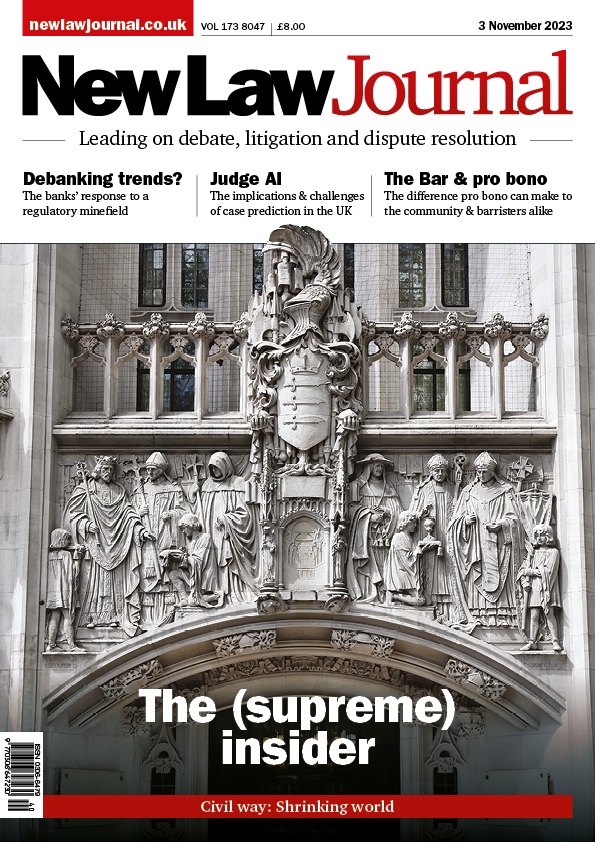


Fixed costs, forced ADR, and animal exploitation jostle for space with legal superstars, good deeds, and a whiff of hope in this month’s update by Dominic Regan
The headlines from the Covid inquiry are writing themselves, so revelatory is the evidence. It seems, however, that there is a never-ending stream of public inquiries, each one lasting an age
The latest word on fixed recoverable costs plus a (potentially seismic) prediction for Christmas feature in NLJ’s The Insider column this week by Professor Dominic Regan of City Law School
In this week’s Civil way, NLJ columnist & former District Judge Stephen Gold relays the good news that the Housing Loss Prevention Advice Service is up and running along with guidance notes and the government’s checklist for renting in England
In this week’s NLJ, Jago Russell, partner, Boutique Law, and Ross Ludlow, pupil barrister, Drystone Chambers, explain the reasons behind the trend for de-banking in the UK. While the Nigel Farage debacle captured the headlines, ‘being de-banked is surprisingly common’, the authors write
As lawyers prepare for Pro Bono Week (6-10 November), Bar Chair Nick Vineall KC offers his own personal take on the difference pro bono can make, in this week’s NLJ. Both lawyer and client benefit from the experience. Vineall recalls his first ever cross-examination, conducted pro bono for a client referred via the Free Representation Unit
Solicitors have highlighted issues in the otherwise broadly welcomed Economic Crime and Corporate Transparency Act 2023
The Law Society asked solicitors last week to share their experience of delivering unbundled services—splitting services into tasks, some carried out by solicitors and the rest completed by clients
MPs have launched an inquiry into the work of the county court, amid long-standing concerns over court capacity and resources
Fees for barristers in cases involving pre-recorded cross-examination of vulnerable witnesses (s 28 cases) are to increase


MOVERS & SHAKERS

Cripps—Radius Law
Commercial and technology practice boosted by team hire

Switalskis—Grimsby
Firm expands with new Grimsby office to serve North East Lincolnshire

Slater Heelis—Will Newman & Lucy Spilsbury
Property team boosted by two solicitor appointments
NEWS
A High Court ruling involving the Longleat estate has exposed the fault line between modern family building and historic trust drafting. Writing in NLJ this week, Charlotte Coyle, director and family law expert at Freeths, examines Cator v Thynn [2026] EWHC 209 (Ch), where trustees sought approval to modernise trusts that retain pre-1970 definitions of ‘child’, ‘grandchild’ and ‘issue’
Fresh proposals to criminalise ‘nudification’ apps, prioritise cyberflashing and non-consensual intimate images, and even ban under-16s from social media have reignited debate over whether the Online Safety Act 2023 (OSA 2023) is fit for purpose. Writing in NLJ this week, Alexander Brown, head of technology, media and telecommunications, and Alexandra Webster, managing associate, Simmons & Simmons, caution against reactive law-making that could undermine the Act’s ‘risk-based and outcomes-focused’ design
Recent allegations surrounding Peter Mandelson and Andrew Mountbatten-Windsor have reignited scrutiny of the ancient common law offence of misconduct in public office. Writing in NLJ this week, Simon Parsons, teaching fellow at Bath Spa University, asks whether their conduct could clear a notoriously high legal hurdle
A landmark ruling has reshaped child clinical negligence claims. Writing in NLJ this week, Jodi Newton, head of birth and paediatric negligence at Osbornes Law, explains how the Supreme Court in CCC v Sheffield Teaching Hospitals NHS Foundation Trust [2026] UKSC 5 has overturned Croke v Wiseman, ending the long-standing bar on children recovering ‘lost years’ earnings
A Court of Appeal ruling has drawn a firm line under party autonomy in arbitration. Writing in NLJ this week, Masood Ahmed, associate professor at the University of Leicester, analyses Gluck v Endzweig [2026] EWCA Civ 145, where a clause allowing arbitrators to amend an award ‘at any time’ was held incompatible with the Arbitration Act 1996
Copyright © 2026 LexisNexis

