

THIS ISSUE
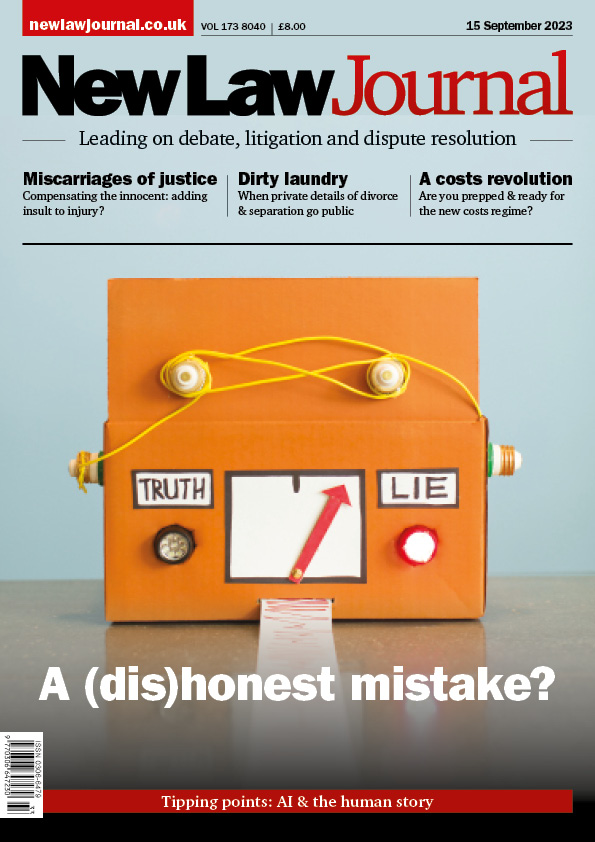


How will artificial intelligence (AI) affect litigation and disputes? Could it improve access to justice? Bring costs down? To what extent and in what areas will it speed the preparation process up? In this week’s NLJ, Eimear McCann, commercial director at TrialView, looks at the range of uses of AI in disputes and considers how this might develop in future.
The horrifying case of Andrew Malkinson, who spent 17 years in prison for a crime he did not commit, is not a one-off or an aberration, NLJ columnist Jon Robins writes in his column this week. Instead, it’s part of a wider systemic problem.
Fixed recoverable costs (FRC) is the issue du jour, with the new regime due to begin on 1 October. In this week’s NLJ, Liam Tolen, senior associate at Ashfords, looks at FRC from an in-house perspective. What do general counsel and in-house legal teams need to know, are there any benefits, how will it affect settlements, and how can they prepare?
The decade-long existence of ‘reckless falsity’ in the context of contempt of court has been rejected by the Court of Appeal. In this week’s NLJ, Sam Thomas, Manon Huckle, Oliver Cooke & Richard Marshall discuss the case of Norman and another v Adler and another and its implications for future contempt cases.
With less than two weeks to go before the extension of fixed recoverable costs (FRC), costs lawyers have urged a six-month delay on the basis the current plans are ‘piecemeal and unreasonable’.
The Sentencing Council has published its response to the recommendations of the Domestic Homicide Sentencing Review, led by Clare Wade KC.
The Ministry of Justice (MoJ) has said that it will not be recommending a policy position or deciding on whether a dual/multiple PIDR should be introduced at this time.
Lord Burnett, the Lord Chief Justice, has sung the praises of cameras in court in his final speech in office.
The Independent Office for Police Conduct (IOPC) has finally apologised to Marcia Rigg for failings in its misconduct investigations into the death of her brother, Sean Rigg at Brixton police station in 2008.
Law Society diversity access scheme (DAS) scholarships have been awarded to 14 aspiring solicitors.


MOVERS & SHAKERS

Bellevue Law—Lianne Craig
Workplace law firm expands commercial disputes team with senior consultant hire

EIP—Rob Barker
IP firm promotes patent attorney to partner

Muckle LLP—Ryan Butler
Banking and restructuring team bolstered by insolvency specialist
NEWS
A High Court ruling involving the Longleat estate has exposed the fault line between modern family building and historic trust drafting. Writing in NLJ this week, Charlotte Coyle, director and family law expert at Freeths, examines Cator v Thynn [2026] EWHC 209 (Ch), where trustees sought approval to modernise trusts that retain pre-1970 definitions of ‘child’, ‘grandchild’ and ‘issue’
Fresh proposals to criminalise ‘nudification’ apps, prioritise cyberflashing and non-consensual intimate images, and even ban under-16s from social media have reignited debate over whether the Online Safety Act 2023 (OSA 2023) is fit for purpose. Writing in NLJ this week, Alexander Brown, head of technology, media and telecommunications, and Alexandra Webster, managing associate, Simmons & Simmons, caution against reactive law-making that could undermine the Act’s ‘risk-based and outcomes-focused’ design
Recent allegations surrounding Peter Mandelson and Andrew Mountbatten-Windsor have reignited scrutiny of the ancient common law offence of misconduct in public office. Writing in NLJ this week, Simon Parsons, teaching fellow at Bath Spa University, asks whether their conduct could clear a notoriously high legal hurdle
A landmark ruling has reshaped child clinical negligence claims. Writing in NLJ this week, Jodi Newton, head of birth and paediatric negligence at Osbornes Law, explains how the Supreme Court in CCC v Sheffield Teaching Hospitals NHS Foundation Trust [2026] UKSC 5 has overturned Croke v Wiseman, ending the long-standing bar on children recovering ‘lost years’ earnings
A Court of Appeal ruling has drawn a firm line under party autonomy in arbitration. Writing in NLJ this week, Masood Ahmed, associate professor at the University of Leicester, analyses Gluck v Endzweig [2026] EWCA Civ 145, where a clause allowing arbitrators to amend an award ‘at any time’ was held incompatible with the Arbitration Act 1996
Copyright © 2026 LexisNexis

