

THIS ISSUE

Stress needn’t be a constant in the lives of lawyers. The damage it can do is real, significant and, thankfully, can be reduced in many situations. In a must-read in this week’s NLJ, Hansa Pankhania, CEO of AUM Wellbeing Consultancy, offers tips and guidance on what to do when stress creeps up.
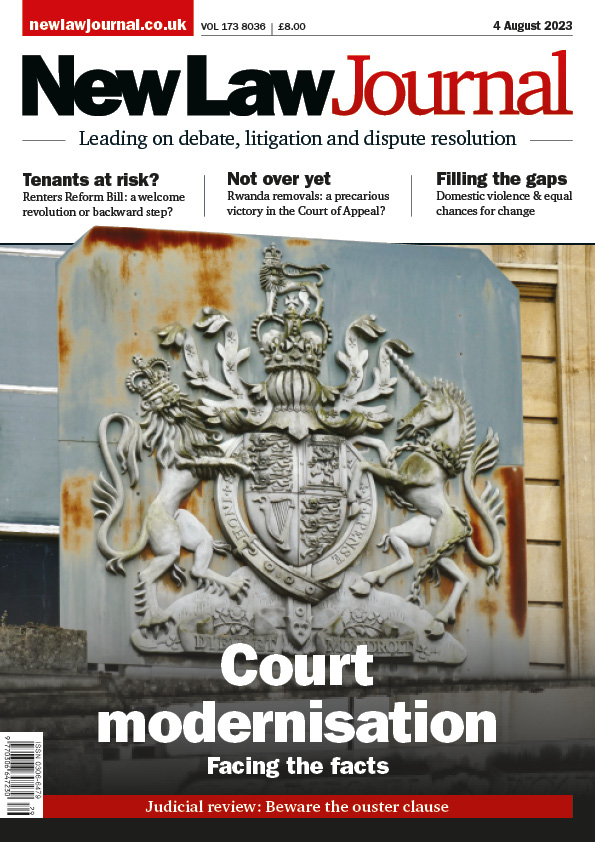
What are they really saying? NLJ columnist and former director of Justice, Roger Smith translates the ‘urbane language’ of the National Audit Office and Public Accounts Committee in this week’s issue, as he casts a critical eye on the progress of the courts & tribunals modernisation programme.
The Renters Reform Bill aims to change the nature of the landlord-tenant relationship, improving tenants’ security while giving greater flexibility to landlords. But can it achieve this? In this week’s NLJ, Gary Scott, partner at Spector, Constant & Williams, assess its chances.
While the Court of Appeal ruling that effectively halted the removal of ten asylum seekers to Rwanda in June was hailed as a victory by campaigners, the reality is less clear-cut, Dr Romit Bhandari writes in this week’s NLJ.
The government succeeded in blocking a potential judicial review, in a recent case on ouster clauses (Oceana). How concerned should we be about this development?

Will the courts & tribunals modernisation programme end up a victim of its own overambition? Roger Smith cuts through the government hype to find the facts
Intended to deliver a ‘renting revolution’, the Renters Reform Bill may ultimately achieve just the opposite: Gary Scott lists some causes for concern
Where is the line between the right to freedom of religion & the lawful expression of that right? Nicholas Dobson examines a complex question for the Employment Appeal Tribunal
In the first of a two-part series, David Burrows puts the case for pre-conditional order approval of financial settlements
The Court of Appeal’s decision on the Rwanda flights is less clear-cut than the outcome suggests, writes Dr Romit Bhandari

MOVERS & SHAKERS

Bellevue Law—Lianne Craig
Workplace law firm expands commercial disputes team with senior consultant hire

EIP—Rob Barker
IP firm promotes patent attorney to partner

Muckle LLP—Ryan Butler
Banking and restructuring team bolstered by insolvency specialist
NEWS
The Supreme Court has delivered a decisive ruling on termination under the JCT Design & Build form. Writing in NLJ this week, Andrew Singer KC and Jonathan Ward, of Kings Chambers, analyse Providence Building Services v Hexagon Housing Association [2026] UKSC 1, which restores the first-instance decision and curbs contractors’ termination rights for repeated late payment
Secondments, disciplinary procedures and appeal chaos all feature in a quartet of recent rulings. Writing in NLJ this week, Ian Smith, barrister and emeritus professor of employment law at UEA, examines how established principles are being tested in modern disputes
The AI revolution is no longer a distant murmur—it’s at the client’s desk. Writing in NLJ this week, Peter Ambrose, CEO of The Partnership and Legalito, warns that the ‘AI chickens’ have ‘come home to roost’, transforming not just legal practice but the lawyer–client relationship itself
A High Court ruling involving the Longleat estate has exposed the fault line between modern family building and historic trust drafting. Writing in NLJ this week, Charlotte Coyle, director and family law expert at Freeths, examines Cator v Thynn [2026] EWHC 209 (Ch), where trustees sought approval to modernise trusts that retain pre-1970 definitions of ‘child’, ‘grandchild’ and ‘issue’
Fresh proposals to criminalise ‘nudification’ apps, prioritise cyberflashing and non-consensual intimate images, and even ban under-16s from social media have reignited debate over whether the Online Safety Act 2023 (OSA 2023) is fit for purpose. Writing in NLJ this week, Alexander Brown, head of technology, media and telecommunications, and Alexandra Webster, managing associate, Simmons & Simmons, caution against reactive law-making that could undermine the Act’s ‘risk-based and outcomes-focused’ design
Copyright © 2026 LexisNexis

