

THIS ISSUE


Andrew Parker reviews the draft rules for extending fixed costs to cases valued up to £100,000
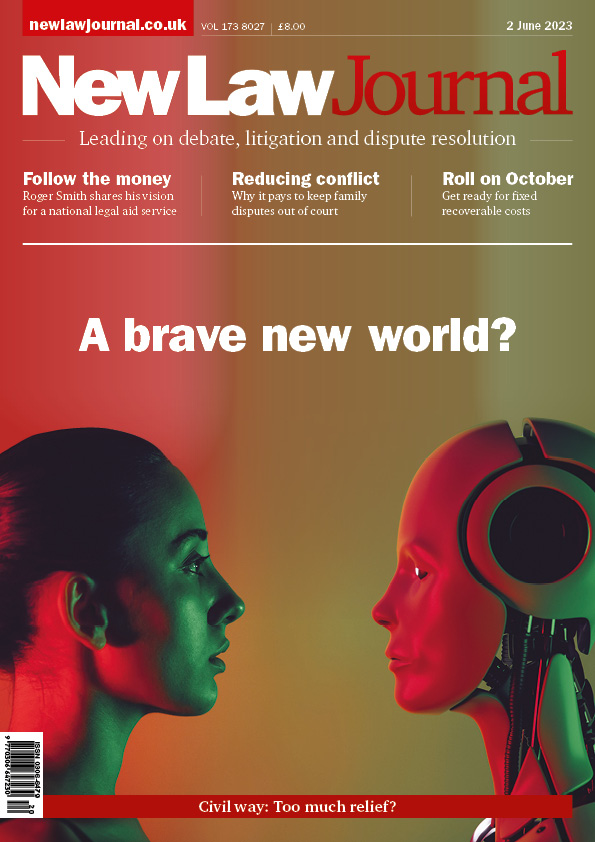
Corporate lawyers should not fear the rise of artificial intelligence (AI), writes Ziad Mantoura, solicitor and senior vice president at alternative legal service provider Epiq, in this week’s NLJ.
In this week’s NLJ, Caroline Bowden, consultant at Anthony Gold, is cautiously optimistic about a Ministry of Justice (MoJ) consultation on the earlier resolution of private family law arrangements for children, finances and housing. The aim is to keep family disputes out of court where possible, an aspiration approved of by family lawyers.
Could Starmer, Davey or Sunak (or whoever becomes the next prime minister) rescue the legal aid system? In this week’s NLJ, columnist Roger Smith looks back to the Cameron-Osborne years of austerity, before examining potential routes back to functionality.
India has opened its legal market to foreign firms. What opportunities have arisen as a result, and what restrictions apply? In this week’s NLJ, Rupa Lakha, partner, and Neeva Desai, trainee solicitor, at Charles Russell Speechlys, take a look at the significant potential for both Indian and foreign law firms.
Roger Smith sets out a vision for a national legal aid service—& how we might go about funding it
Professor Graham Zellick KC considers the use of the designation KC by honorary silks
For many participants in a family dispute, almost any alternative is better than ending up in court. Caroline Bowden hopes the government will succeed in getting this message across
What is an accident? Asela Wijeyaratne & Mark Welbourn examine a return to orthodoxy under the Montreal Convention on air passenger liability
Wilson Leung examines a recent judgment providing much-needed clarity on the process of bringing committal proceedings in Hong Kong

MOVERS & SHAKERS

Bellevue Law—Lianne Craig
Workplace law firm expands commercial disputes team with senior consultant hire

EIP—Rob Barker
IP firm promotes patent attorney to partner

Muckle LLP—Ryan Butler
Banking and restructuring team bolstered by insolvency specialist
NEWS
The Supreme Court has delivered a decisive ruling on termination under the JCT Design & Build form. Writing in NLJ this week, Andrew Singer KC and Jonathan Ward, of Kings Chambers, analyse Providence Building Services v Hexagon Housing Association [2026] UKSC 1, which restores the first-instance decision and curbs contractors’ termination rights for repeated late payment
Secondments, disciplinary procedures and appeal chaos all feature in a quartet of recent rulings. Writing in NLJ this week, Ian Smith, barrister and emeritus professor of employment law at UEA, examines how established principles are being tested in modern disputes
The AI revolution is no longer a distant murmur—it’s at the client’s desk. Writing in NLJ this week, Peter Ambrose, CEO of The Partnership and Legalito, warns that the ‘AI chickens’ have ‘come home to roost’, transforming not just legal practice but the lawyer–client relationship itself
A High Court ruling involving the Longleat estate has exposed the fault line between modern family building and historic trust drafting. Writing in NLJ this week, Charlotte Coyle, director and family law expert at Freeths, examines Cator v Thynn [2026] EWHC 209 (Ch), where trustees sought approval to modernise trusts that retain pre-1970 definitions of ‘child’, ‘grandchild’ and ‘issue’
Fresh proposals to criminalise ‘nudification’ apps, prioritise cyberflashing and non-consensual intimate images, and even ban under-16s from social media have reignited debate over whether the Online Safety Act 2023 (OSA 2023) is fit for purpose. Writing in NLJ this week, Alexander Brown, head of technology, media and telecommunications, and Alexandra Webster, managing associate, Simmons & Simmons, caution against reactive law-making that could undermine the Act’s ‘risk-based and outcomes-focused’ design
Copyright © 2026 LexisNexis

