

THIS ISSUE
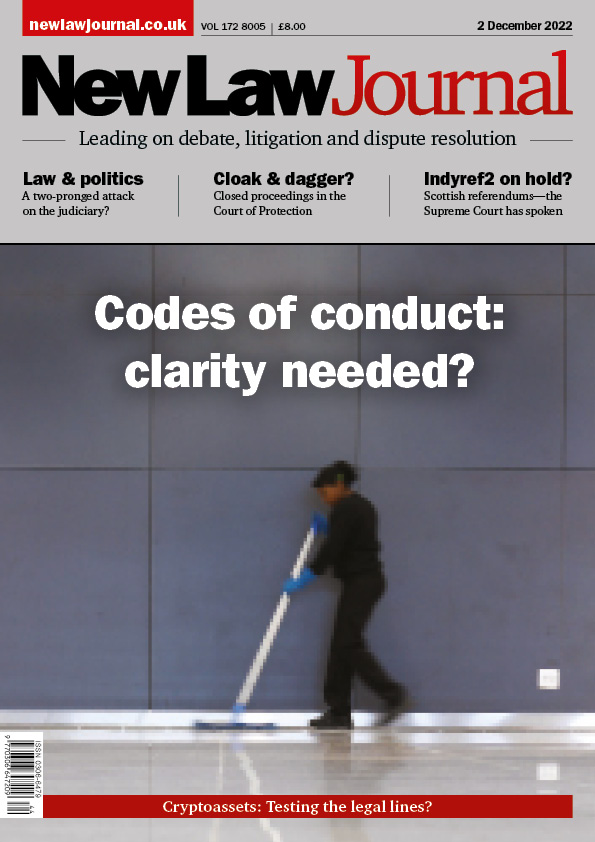

Professor Marc Weller provides a fascinating insight into the Supreme Court’s ruling that Westminster’s permission is required before a referendum on Scottish independence can go ahead. Professor Weller, of Cambridge University, examines the case, in this week’s NLJ.
‘Depicting the ECHR and HRA 1998 as alien intrusions undermining British sovereignty is historically illiterate,’ Sir Geoffrey Bindman KC writes in this week’s NLJ. Bindman asks: ‘What is behind this assault on the judiciary, the ECHR and HRA 1998?’
To what extent do the rules of the profession apply to non-solicitor employees? More than you may think. In this week’s NLJ, John Gould, senior partner at Russell-Cooke, writes: ‘Surprisingly, every employee within a firm is a regulated person whether or not they are personally engaged in reserved legal activity.’
Closed proceedings and covert medication? A recent case has created alarm. Is the Court of Protection too secretive? Are sufficient safeguards in place? In the first of a two-part series in NLJ, Dr Laura Davidson, of No5 Chambers, looks into a recent case concerning a vulnerable 20-year-old.
Falling out and making up again—what happens when a couple get divorced then reconcile? Writing in this week’s NLJ, family law solicitor-advocate and NLJ columnist, David Burrows looks at the legal implications of this rom-com scenario.

The ongoing assault on the judiciary, the European Convention on Human Rights & the Human Rights Act is authoritarian & undemocratic, says Sir Geoffrey Bindman KC
Getting back together? David Burrows examines the setting aside of divorce orders where a couple has reconciled
Closed proceedings & covert medication. In the first of a two-part series, Dr Laura Davidson asks if the Court of Protection has retreated to the realm of secrecy
The Supreme Court has ruled that a second referendum on Scottish independence cannot go ahead without Westminster’s permission: Marc Weller examines its judgment

MOVERS & SHAKERS

Cripps—Radius Law
Commercial and technology practice boosted by team hire

Switalskis—Grimsby
Firm expands with new Grimsby office to serve North East Lincolnshire

Slater Heelis—Will Newman & Lucy Spilsbury
Property team boosted by two solicitor appointments
NEWS
The Supreme Court has delivered a decisive ruling on termination under the JCT Design & Build form. Writing in NLJ this week, Andrew Singer KC and Jonathan Ward, of Kings Chambers, analyse Providence Building Services v Hexagon Housing Association [2026] UKSC 1, which restores the first-instance decision and curbs contractors’ termination rights for repeated late payment
Secondments, disciplinary procedures and appeal chaos all feature in a quartet of recent rulings. Writing in NLJ this week, Ian Smith, barrister and emeritus professor of employment law at UEA, examines how established principles are being tested in modern disputes
The AI revolution is no longer a distant murmur—it’s at the client’s desk. Writing in NLJ this week, Peter Ambrose, CEO of The Partnership and Legalito, warns that the ‘AI chickens’ have ‘come home to roost’, transforming not just legal practice but the lawyer–client relationship itself
A High Court ruling involving the Longleat estate has exposed the fault line between modern family building and historic trust drafting. Writing in NLJ this week, Charlotte Coyle, director and family law expert at Freeths, examines Cator v Thynn [2026] EWHC 209 (Ch), where trustees sought approval to modernise trusts that retain pre-1970 definitions of ‘child’, ‘grandchild’ and ‘issue’
Fresh proposals to criminalise ‘nudification’ apps, prioritise cyberflashing and non-consensual intimate images, and even ban under-16s from social media have reignited debate over whether the Online Safety Act 2023 (OSA 2023) is fit for purpose. Writing in NLJ this week, Alexander Brown, head of technology, media and telecommunications, and Alexandra Webster, managing associate, Simmons & Simmons, caution against reactive law-making that could undermine the Act’s ‘risk-based and outcomes-focused’ design
Copyright © 2026 LexisNexis

