

THIS ISSUE


The invasion of Ukraine and subsequent focus on sanctions has put the spotlight on illicit wealth. Is it time to introduce a failure to prevent economic crime offence?
Former District Judge Stephen Gold dips into the tale of clinical negligence by four separate dentists working from the same practice, in this week’s Civil Way
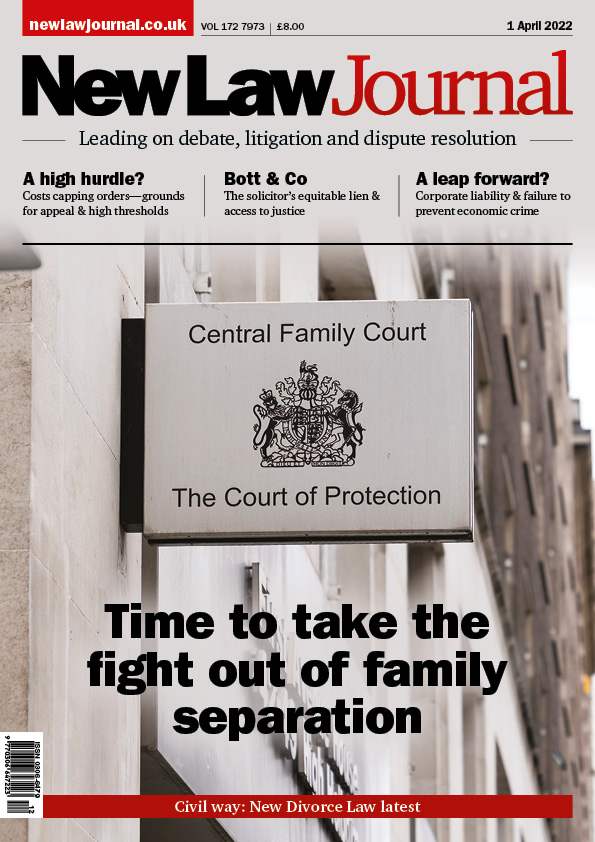
With fault-free divorce set to come in from 6 April, its time to radically reform the system for separating families, with better support for children and parents, writes Lauren Evans, senior associate, Kingsley Napley, in this week’s NLJ
It’s a buoyant legal jobs market at the moment. Writing in this week’s NLJ, Chris Ball, head of recruitment at gunnercooke, reports on the top trends in legal recruitment from the move to embrace different ways of working to the increasing importance of law firm culture
The Sentencing Council has proposed its first set of guidelines for the offences of perverting the course of justice and witness intimidation
The Home Secretary unlawfully seized more than 2000 mobile phones from asylum seekers and extracted vast amounts of data, the High Court has held
The President of the Family Division, Sir Andrew McFarlane, has issued guidance on the impact of the family court’s approach to costs of the Divorce, Dissolution and Separation Act 2020
The Bar Council is gathering names of barristers and judges who want to sponsor Ukrainian lawyers to come to the UK, and is hoping to match them with Ukrainian colleagues
Nine out of ten law firms are facing pressure from clients to reduce costs and use different billing arrangements, according to a survey of 200 partners by litigation funder, Harbour
A tool to help law firms assess the cybersecurity arrangements of the chambers whose barristers they instruct has been launched by the Bar Council and Law Society


MOVERS & SHAKERS

Cripps—Radius Law
Commercial and technology practice boosted by team hire

Switalskis—Grimsby
Firm expands with new Grimsby office to serve North East Lincolnshire

Slater Heelis—Will Newman & Lucy Spilsbury
Property team boosted by two solicitor appointments
NEWS
The Supreme Court has delivered a decisive ruling on termination under the JCT Design & Build form. Writing in NLJ this week, Andrew Singer KC and Jonathan Ward, of Kings Chambers, analyse Providence Building Services v Hexagon Housing Association [2026] UKSC 1, which restores the first-instance decision and curbs contractors’ termination rights for repeated late payment
Secondments, disciplinary procedures and appeal chaos all feature in a quartet of recent rulings. Writing in NLJ this week, Ian Smith, barrister and emeritus professor of employment law at UEA, examines how established principles are being tested in modern disputes
The AI revolution is no longer a distant murmur—it’s at the client’s desk. Writing in NLJ this week, Peter Ambrose, CEO of The Partnership and Legalito, warns that the ‘AI chickens’ have ‘come home to roost’, transforming not just legal practice but the lawyer–client relationship itself
A High Court ruling involving the Longleat estate has exposed the fault line between modern family building and historic trust drafting. Writing in NLJ this week, Charlotte Coyle, director and family law expert at Freeths, examines Cator v Thynn [2026] EWHC 209 (Ch), where trustees sought approval to modernise trusts that retain pre-1970 definitions of ‘child’, ‘grandchild’ and ‘issue’
Fresh proposals to criminalise ‘nudification’ apps, prioritise cyberflashing and non-consensual intimate images, and even ban under-16s from social media have reignited debate over whether the Online Safety Act 2023 (OSA 2023) is fit for purpose. Writing in NLJ this week, Alexander Brown, head of technology, media and telecommunications, and Alexandra Webster, managing associate, Simmons & Simmons, caution against reactive law-making that could undermine the Act’s ‘risk-based and outcomes-focused’ design
Copyright © 2026 LexisNexis

