
header-logo header-logo

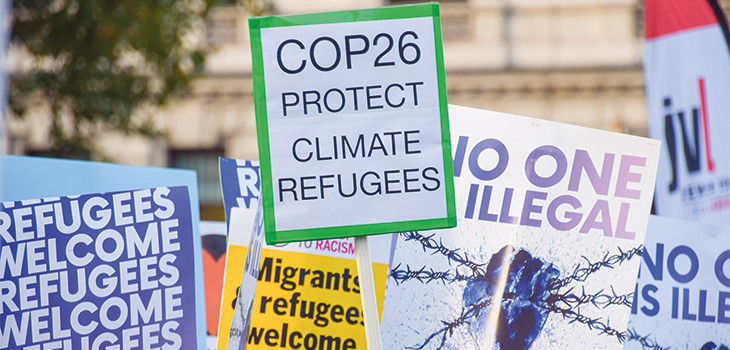
Climate refugees: a 21st century crisis

24 November 2021 / Sharmistha Michaels
Issue: 7958 / Categories: Opinion , Immigration & asylum
printer mail-detail
65084
Is the law in place to protect people who are forcibly displaced by environmental disaster? Sharmistha Michaels investigates

The world has warmed up by around 1.2°C since the 19th century. This has had a catastrophic effect on civilization: global sea levels reaching a record high; Greenland’s enormous ice sheet melting faster than ever; floods deluging parts of Europe and China; and wildfires raging through forests and homes worldwide (see the World Meteorological Organization’s report State of Climate in 2021).

Novels like John Lanchester’s The Wall paint a dystopian picture of millions of people across the globe being displaced by climate change and seeking shelter. Britain’s response is to create a wall of its coastline to bar entry, in keeping with its post-Brexit anti-refugee attitude. Tales like his are no longer harbingers of a future dystopian crisis. The crisis is here now. Numbers affected are growing fast. By 2030, climate change could force 216 million people to migrate as hotspots of internal climate migration start to emerge (see the World

If you are not a subscriber, subscribe now to read this content
If you are already a subscriber sign in
...or Register for two weeks' free access to subscriber content

MOVERS & SHAKERS

Quinn Emanuel—James McSweeney

Quinn Emanuel—James McSweeney

London promotion underscores firm’s investment in white collar and investigations

Ward Hadaway—Louise Miller

Ward Hadaway—Louise Miller

Private client team strengthened by partner appointment

NLJ Career Profile: Kate Gaskell, Flex Legal

NLJ Career Profile: Kate Gaskell, Flex Legal

Kate Gaskell, CEO of Flex Legal, reflects on chasing her childhood dreams underscores the importance of welcoming those from all backgrounds into the profession

NEWS
Overcrowded prisons, mental health hospitals and immigration centres are failing to meet international and domestic human rights standards, the National Preventive Mechanism (NPM) has warned
Two speedier and more streamlined qualification routes have been launched for probate and conveyancing professionals
Workplace stress was a contributing factor in almost one in eight cases before the employment tribunal last year, indicating its endemic grip on the UK workplace
In Ward v Rai, the High Court reaffirmed that imprecise points of dispute can and will be struck out. Writing in NLJ this week, Amy Dunkley of Bolt Burdon Kemp reports on the decision and its implications for practitioners
Could the Supreme Court’s ruling in R v Hayes; R v Palombo unintentionally unsettle future complex fraud trials? Maia Cohen-Lask of Corker Binning explores the question in NLJ this week
back-to-top-scroll
