

THIS ISSUE
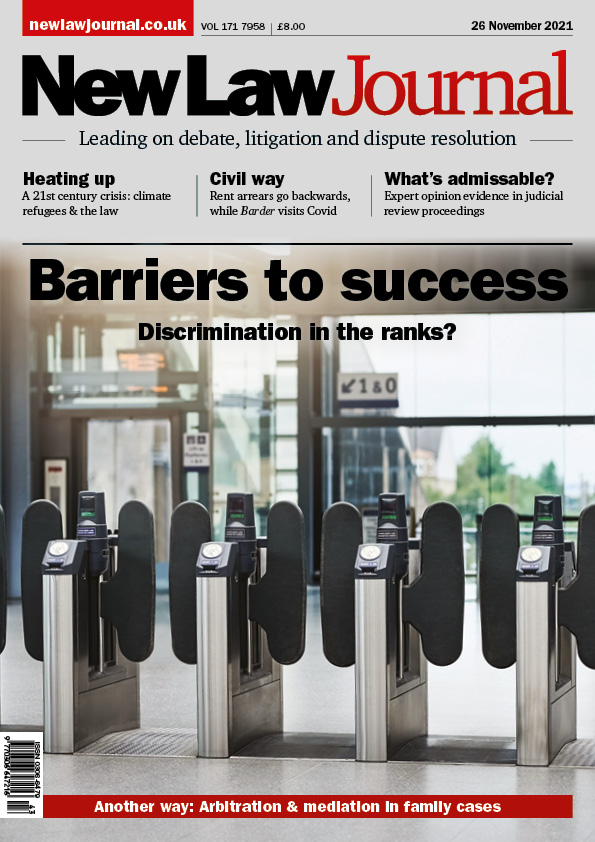

A crisis of culture: the legal sector risks losing talented lawyers who don’t fit the traditional mould, says CILEX Chair Professor Chris Bones

Veronica Cowan talks to the Chief Legal Ombudsman, Paul McFadden, about his plans to drive recovery & change
An employment tribunal has given the first UK ruling on indirect associative discrimination: Charles Pigott reports
Lois Horne reviews a case where the Privy Council delivered a ‘ground-breaking’ judgment on injunctions
Nicholas Dobson examines expert opinion evidence in judicial review proceedings
Rent arrears go backwards; Barder visits Covid; PI PAP PERFECTED; Enforcement stays; Law at Night; Memos with threats
Vexatious litigants, lacklustre lodgings & tight turnaround times: Dominic Regan ponders the downsides of a seat on the High Court bench
Hannah Gumbrill-Ward shares the pros & cons of the use of arbitration in family proceedings
You’d be forgiven for thinking that the legal sector has lagged behind many other sectors in terms of technology adoption across the years. However, in recent times we have started to see a shift in both mindset and practice, with various Software as a Service-based products coming into play and covering everything from basic practice management through to AI-driven automation. To better understand the impact of this technology within the sector and more specifically, the probate process, Exizent’s Chief Technology Officer, John Catnach, discusses the latest technology within the industry and what the future trends look like

MOVERS & SHAKERS

Cripps—Radius Law
Commercial and technology practice boosted by team hire

Switalskis—Grimsby
Firm expands with new Grimsby office to serve North East Lincolnshire

Slater Heelis—Will Newman & Lucy Spilsbury
Property team boosted by two solicitor appointments
NEWS
A High Court ruling involving the Longleat estate has exposed the fault line between modern family building and historic trust drafting. Writing in NLJ this week, Charlotte Coyle, director and family law expert at Freeths, examines Cator v Thynn [2026] EWHC 209 (Ch), where trustees sought approval to modernise trusts that retain pre-1970 definitions of ‘child’, ‘grandchild’ and ‘issue’
Fresh proposals to criminalise ‘nudification’ apps, prioritise cyberflashing and non-consensual intimate images, and even ban under-16s from social media have reignited debate over whether the Online Safety Act 2023 (OSA 2023) is fit for purpose. Writing in NLJ this week, Alexander Brown, head of technology, media and telecommunications, and Alexandra Webster, managing associate, Simmons & Simmons, caution against reactive law-making that could undermine the Act’s ‘risk-based and outcomes-focused’ design
Recent allegations surrounding Peter Mandelson and Andrew Mountbatten-Windsor have reignited scrutiny of the ancient common law offence of misconduct in public office. Writing in NLJ this week, Simon Parsons, teaching fellow at Bath Spa University, asks whether their conduct could clear a notoriously high legal hurdle
A landmark ruling has reshaped child clinical negligence claims. Writing in NLJ this week, Jodi Newton, head of birth and paediatric negligence at Osbornes Law, explains how the Supreme Court in CCC v Sheffield Teaching Hospitals NHS Foundation Trust [2026] UKSC 5 has overturned Croke v Wiseman, ending the long-standing bar on children recovering ‘lost years’ earnings
A Court of Appeal ruling has drawn a firm line under party autonomy in arbitration. Writing in NLJ this week, Masood Ahmed, associate professor at the University of Leicester, analyses Gluck v Endzweig [2026] EWCA Civ 145, where a clause allowing arbitrators to amend an award ‘at any time’ was held incompatible with the Arbitration Act 1996
Copyright © 2026 LexisNexis

