

THIS ISSUE
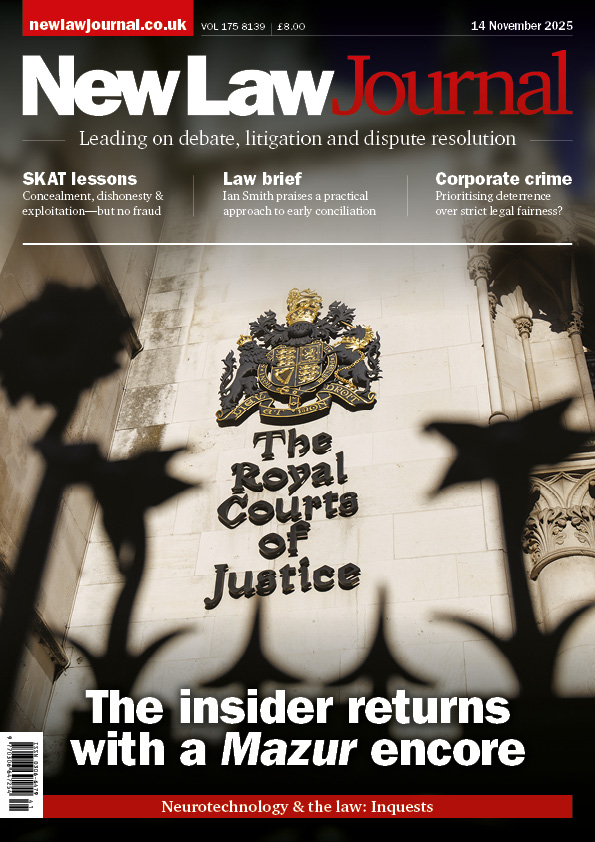

Mazur v Charles Russell Speechlys LLP [2025] EWHC 2341 (KB) continues to stir controversy across civil litigation, according to NLJ columnist Professor Dominic Regan of City Law School—AKA ‘The insider’
SRA v Goodwin is a rare disciplinary decision where a solicitor found to have acted dishonestly avoided being struck off, says Clare Hughes-Williams of DAC Beachcroft in this week's NLJ. The Solicitors Disciplinary Tribunal (SDT) imposed a 12-month suspension instead, citing medical evidence and the absence of harm to clients
In their latest Family Law Brief for NLJ, Ellie Hampson-Jones and Carla Ditz of Stewarts review three key family law rulings, including the latest instalment in the long-running saga of Potanin v Potanina
The Asian International Arbitration Centre’s sweeping reforms through its AIAC Suite of Rules 2026, unveiled at Asia ADR Week, are under examination in this week's NLJ by John (Ching Jack) Choi of Gresham Legal

The Asian International Arbitration Centre has launched its new rules. John (Ching Jack) Choi sets out the main institutional & procedural reforms
The senior manager test—as set out in the Crime and Policing Bill—prioritises deterrence over strict legal fairness, writes Tom McNeill
In this week's issue of NLJ, Yasseen Gailani and Alexander Martin of Quinn Emanuel report on the High Court’s decision in Skatteforvaltningen (SKAT) v Solo Capital Partners LLP & Ors [2025], where Denmark’s tax authority failed to recover £1.4bn in disputed dividend tax refunds
Mazur is still grabbing all the headlines. And rightly so, says Dominic Regan, amid rumblings that the decision was wrongly decided
Harry Lambert of Outer Temple Chambers continues his captivating series for NLJ, this time exploring how emerging neurotechnology may revolutionise coronial law. With devices like Apple’s EEG-enabled AirPods and Meta’s Neural Band capturing brain activity, Lambert argues coroners could soon analyse neural data to determine cause, intent, and timing of death
Out with the old, in with the new: Ian Smith praises a practical approach to early conciliation, plus runs through whistleblowing detriment & future loss

MOVERS & SHAKERS

Cripps—Radius Law
Commercial and technology practice boosted by team hire

Switalskis—Grimsby
Firm expands with new Grimsby office to serve North East Lincolnshire

Slater Heelis—Will Newman & Lucy Spilsbury
Property team boosted by two solicitor appointments
NEWS
The Supreme Court has delivered a decisive ruling on termination under the JCT Design & Build form. Writing in NLJ this week, Andrew Singer KC and Jonathan Ward, of Kings Chambers, analyse Providence Building Services v Hexagon Housing Association [2026] UKSC 1, which restores the first-instance decision and curbs contractors’ termination rights for repeated late payment
Secondments, disciplinary procedures and appeal chaos all feature in a quartet of recent rulings. Writing in NLJ this week, Ian Smith, barrister and emeritus professor of employment law at UEA, examines how established principles are being tested in modern disputes
The AI revolution is no longer a distant murmur—it’s at the client’s desk. Writing in NLJ this week, Peter Ambrose, CEO of The Partnership and Legalito, warns that the ‘AI chickens’ have ‘come home to roost’, transforming not just legal practice but the lawyer–client relationship itself
A High Court ruling involving the Longleat estate has exposed the fault line between modern family building and historic trust drafting. Writing in NLJ this week, Charlotte Coyle, director and family law expert at Freeths, examines Cator v Thynn [2026] EWHC 209 (Ch), where trustees sought approval to modernise trusts that retain pre-1970 definitions of ‘child’, ‘grandchild’ and ‘issue’
Fresh proposals to criminalise ‘nudification’ apps, prioritise cyberflashing and non-consensual intimate images, and even ban under-16s from social media have reignited debate over whether the Online Safety Act 2023 (OSA 2023) is fit for purpose. Writing in NLJ this week, Alexander Brown, head of technology, media and telecommunications, and Alexandra Webster, managing associate, Simmons & Simmons, caution against reactive law-making that could undermine the Act’s ‘risk-based and outcomes-focused’ design
Copyright © 2026 LexisNexis

