

THIS ISSUE
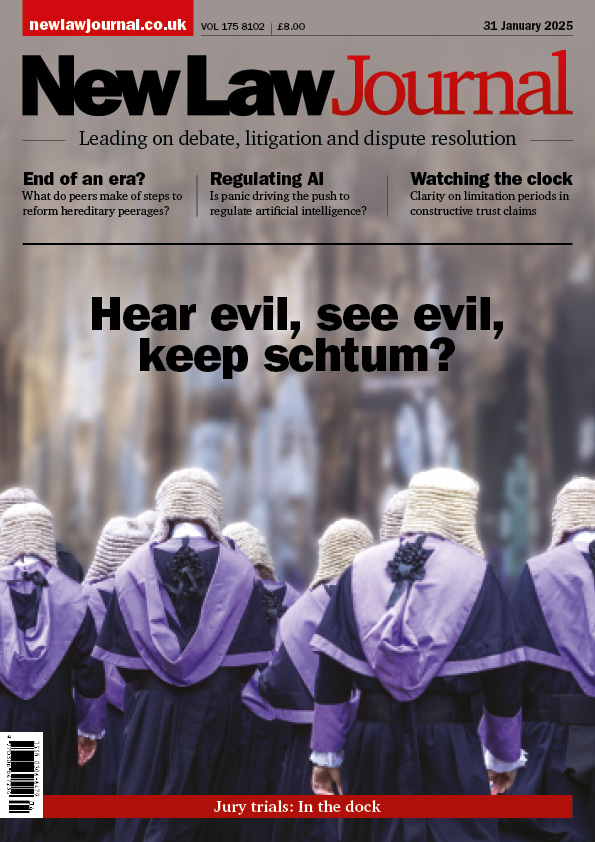

Retired judge Dr Victoria McCloud shares her thoughts regarding judicial ‘leadership’, social media guidance and the Judicial Conduct Investigations Office, in this week’s NLJ.
Faced with an unwieldy and ever-rising backlog of cases at the Crown Court, the Ministry of Justice is considering introducing an ‘intermediate tier’ and has put Sir Brian Leveson in charge of a review. In this week’s NLJ, Charles Kuhn, partner at Clyde & Co, examines the possibilities, the potential savings and the impact on justice.
Artificial intelligence (AI) technology may be developing fast but—contrary to popular opinion—the ’panicked rush to legislation’ to regulate it is not necessary, writes Ian McDougall, president of the LexisNexis Rule of Law Foundation & adjunct professor, IE University Law School, in this week’s NLJ.
The responsibilities of paralegals have expanded considerably, as have their career options, Amanda Hamilton, Patron of the National Association of Licensed Paralegals, writes in this week’s NLJ. Some use the experience as a stepping stone into a career as solicitor or barrister, while others develop a specialism in a particular area.
Former district judge Stephen Gold covers a recent landlord and tenant case that was leapfrogged to the Court of Appeal due to its importance, in this week’s NLJ. The case, Switaj v McClenaghan, concerns a check-out fee.

Retired judge Victoria McCloud gives a personal analysis of the implications of new restrictions on judges’ freedom of speech in England & Wales
What will be the verdict on replacing juries with an intermediate tier? Charles Kuhn examines the evidence
Imogen Dodds & Jamie Sutherland consider a Hong Kong case that gives clarity on limitation periods in constructive trust claims
What do the peers make of the Bill seeking to reform hereditary peerage? Neil Parpworth reports back from the House of Lords
Does the Human Rights Act 1998 undermine parliamentary sovereignty? A recent Policy Exchange paper argues that it does. Nicholas Dobson explores the issues

MOVERS & SHAKERS

Bellevue Law—Lianne Craig
Workplace law firm expands commercial disputes team with senior consultant hire

EIP—Rob Barker
IP firm promotes patent attorney to partner

Muckle LLP—Ryan Butler
Banking and restructuring team bolstered by insolvency specialist
NEWS
The Supreme Court has delivered a decisive ruling on termination under the JCT Design & Build form. Writing in NLJ this week, Andrew Singer KC and Jonathan Ward, of Kings Chambers, analyse Providence Building Services v Hexagon Housing Association [2026] UKSC 1, which restores the first-instance decision and curbs contractors’ termination rights for repeated late payment
Secondments, disciplinary procedures and appeal chaos all feature in a quartet of recent rulings. Writing in NLJ this week, Ian Smith, barrister and emeritus professor of employment law at UEA, examines how established principles are being tested in modern disputes
The AI revolution is no longer a distant murmur—it’s at the client’s desk. Writing in NLJ this week, Peter Ambrose, CEO of The Partnership and Legalito, warns that the ‘AI chickens’ have ‘come home to roost’, transforming not just legal practice but the lawyer–client relationship itself
A High Court ruling involving the Longleat estate has exposed the fault line between modern family building and historic trust drafting. Writing in NLJ this week, Charlotte Coyle, director and family law expert at Freeths, examines Cator v Thynn [2026] EWHC 209 (Ch), where trustees sought approval to modernise trusts that retain pre-1970 definitions of ‘child’, ‘grandchild’ and ‘issue’
Fresh proposals to criminalise ‘nudification’ apps, prioritise cyberflashing and non-consensual intimate images, and even ban under-16s from social media have reignited debate over whether the Online Safety Act 2023 (OSA 2023) is fit for purpose. Writing in NLJ this week, Alexander Brown, head of technology, media and telecommunications, and Alexandra Webster, managing associate, Simmons & Simmons, caution against reactive law-making that could undermine the Act’s ‘risk-based and outcomes-focused’ design
Copyright © 2026 LexisNexis

