

THIS ISSUE


An ‘unsuccessful, widely-reported prosecution’ proved to be ‘an unbeatable marketing tool’ for D H Lawrence novel, Lady Chatterley’s Lover. In this week’s NLJ, freelance feature writer William Gibson revisits the notorious trial
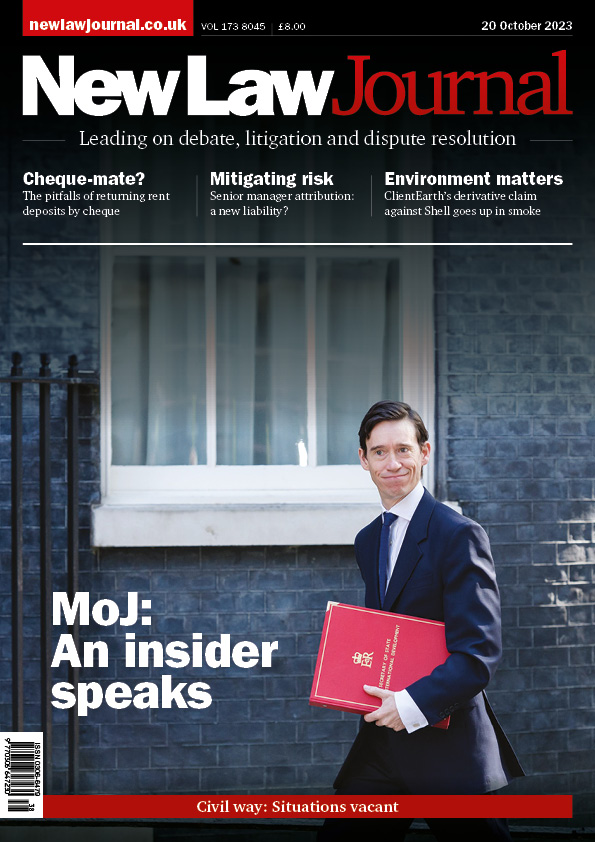
Former JUSTICE director Roger Smith hunts out the serious points among the ‘tittle tattle’ of former prisons minister Rory Stewart’s heavily promoted book, in his NLJ column this week
This week, Michell de Kluyver, Nichola Peters & Harriet Territt, global investigations practice, Addleshaw Goddard, look at the potential introduction of ‘senior manager attribution liability’. As the authors explain, this is a ‘new breed’ of corporate criminal liability, and a definite ‘game changer’
Former district judge Stephen Gold is on form in this week’s Civil way, literally as well as figuratively, as he reports on updates to’N181’ as a result of the fixed recoverable costs reforms
The ‘return’ of a cheque posed a conundrum for the courts in a recent case about the return of a tenant’s deposit on a rented flat. In this week’s NLJ, Edward Blakeney and Fern Schofield, barristers at Falcon Chambers, examine the case along with the ‘surprisingly knotty problem of returning tenancy deposits by cheque and the surprisingly limited amount of authority on this question’
Red Lion Chambers barrister Jonathan Fisher KC has been appointed by the Ministry of Justice to lead an independent review into the disclosure regime and fraud offences
Online court services are adding to delays and undermining access to justice, research by the Law Society has found
The Ministry of Justice (MoJ) has published proposals to reform Supreme Court fees and raise an extra £170,000–£210,000 per year
The Crown Court backlog has hit a record high of more than 65,000 cases, the latest figures reveal
The government will legislate to create a presumption that sentences of less than 12 months should be suspended, the Lord Chancellor, Alex Chalk has told MPs


MOVERS & SHAKERS

Bellevue Law—Lianne Craig
Workplace law firm expands commercial disputes team with senior consultant hire

EIP—Rob Barker
IP firm promotes patent attorney to partner

Muckle LLP—Ryan Butler
Banking and restructuring team bolstered by insolvency specialist
NEWS
A High Court ruling involving the Longleat estate has exposed the fault line between modern family building and historic trust drafting. Writing in NLJ this week, Charlotte Coyle, director and family law expert at Freeths, examines Cator v Thynn [2026] EWHC 209 (Ch), where trustees sought approval to modernise trusts that retain pre-1970 definitions of ‘child’, ‘grandchild’ and ‘issue’
Fresh proposals to criminalise ‘nudification’ apps, prioritise cyberflashing and non-consensual intimate images, and even ban under-16s from social media have reignited debate over whether the Online Safety Act 2023 (OSA 2023) is fit for purpose. Writing in NLJ this week, Alexander Brown, head of technology, media and telecommunications, and Alexandra Webster, managing associate, Simmons & Simmons, caution against reactive law-making that could undermine the Act’s ‘risk-based and outcomes-focused’ design
Recent allegations surrounding Peter Mandelson and Andrew Mountbatten-Windsor have reignited scrutiny of the ancient common law offence of misconduct in public office. Writing in NLJ this week, Simon Parsons, teaching fellow at Bath Spa University, asks whether their conduct could clear a notoriously high legal hurdle
A landmark ruling has reshaped child clinical negligence claims. Writing in NLJ this week, Jodi Newton, head of birth and paediatric negligence at Osbornes Law, explains how the Supreme Court in CCC v Sheffield Teaching Hospitals NHS Foundation Trust [2026] UKSC 5 has overturned Croke v Wiseman, ending the long-standing bar on children recovering ‘lost years’ earnings
A Court of Appeal ruling has drawn a firm line under party autonomy in arbitration. Writing in NLJ this week, Masood Ahmed, associate professor at the University of Leicester, analyses Gluck v Endzweig [2026] EWCA Civ 145, where a clause allowing arbitrators to amend an award ‘at any time’ was held incompatible with the Arbitration Act 1996
Copyright © 2026 LexisNexis

