

THIS ISSUE

Internal promotions boost Real Estate & Construction practice

William Gibson on how an unsuccessful, widely-reported prosecution proved to be an unbeatable marketing tool
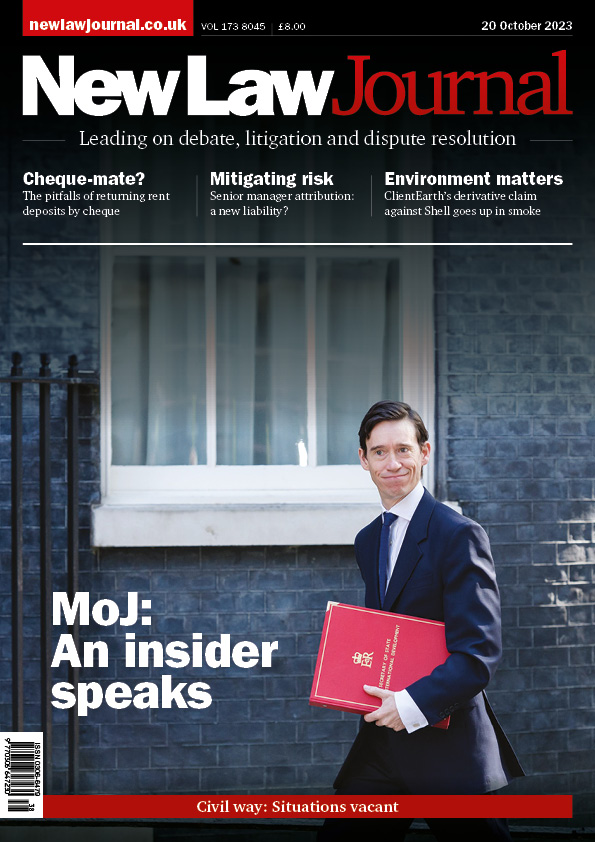
Richard Raban-Williams & John Doherty review an innovative attempt to challenge Shell’s climate change policies
Edward Blakeney & Fern Schofield on the pitfalls of returning deposits by cheque
Roger Smith reports on politics on the edge
Michelle de Kluyver, Nichola Peters & Harriet Territt discuss whether the Economic Crime & Corporate Transparency Bill creates a new breed of corporate criminal liability in the UK
Could India match or even exceed Singapore’s rise in the arbitration space? Saurabh Bhagotra investigates
Rona Epstein & Hugh Williams report on the background & history of sentencing a parent of dependent children
Situations vacant; Revised CPR forms; Enforcement fees to rise; Child report crisis; Social landlords watch out; Fighting against divorce

MOVERS & SHAKERS

Cripps—Radius Law
Commercial and technology practice boosted by team hire

Switalskis—Grimsby
Firm expands with new Grimsby office to serve North East Lincolnshire

Slater Heelis—Will Newman & Lucy Spilsbury
Property team boosted by two solicitor appointments
NEWS
A High Court ruling involving the Longleat estate has exposed the fault line between modern family building and historic trust drafting. Writing in NLJ this week, Charlotte Coyle, director and family law expert at Freeths, examines Cator v Thynn [2026] EWHC 209 (Ch), where trustees sought approval to modernise trusts that retain pre-1970 definitions of ‘child’, ‘grandchild’ and ‘issue’
Fresh proposals to criminalise ‘nudification’ apps, prioritise cyberflashing and non-consensual intimate images, and even ban under-16s from social media have reignited debate over whether the Online Safety Act 2023 (OSA 2023) is fit for purpose. Writing in NLJ this week, Alexander Brown, head of technology, media and telecommunications, and Alexandra Webster, managing associate, Simmons & Simmons, caution against reactive law-making that could undermine the Act’s ‘risk-based and outcomes-focused’ design
Recent allegations surrounding Peter Mandelson and Andrew Mountbatten-Windsor have reignited scrutiny of the ancient common law offence of misconduct in public office. Writing in NLJ this week, Simon Parsons, teaching fellow at Bath Spa University, asks whether their conduct could clear a notoriously high legal hurdle
A landmark ruling has reshaped child clinical negligence claims. Writing in NLJ this week, Jodi Newton, head of birth and paediatric negligence at Osbornes Law, explains how the Supreme Court in CCC v Sheffield Teaching Hospitals NHS Foundation Trust [2026] UKSC 5 has overturned Croke v Wiseman, ending the long-standing bar on children recovering ‘lost years’ earnings
A Court of Appeal ruling has drawn a firm line under party autonomy in arbitration. Writing in NLJ this week, Masood Ahmed, associate professor at the University of Leicester, analyses Gluck v Endzweig [2026] EWCA Civ 145, where a clause allowing arbitrators to amend an award ‘at any time’ was held incompatible with the Arbitration Act 1996
Copyright © 2026 LexisNexis

