

THIS ISSUE

The much-anticipated ruling of the Supreme Court in Philipp v Barclays Bank, which overturned the Court of Appeal’s decision, is discussed from the perspective of consumer safeguarding, in this week’s NLJ.
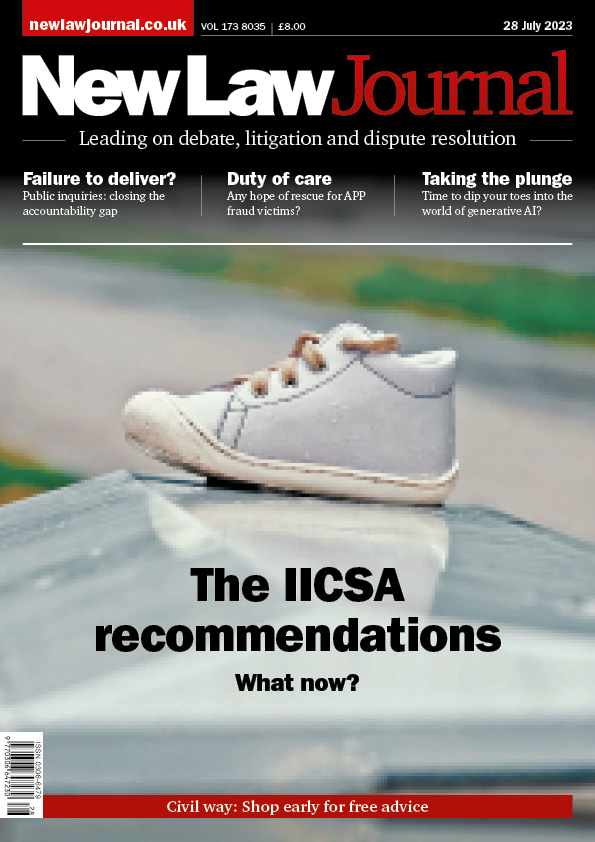
In this week’s NLJ, Maryam Syed, criminal and family barrister at 7BR, discusses the path forward for those who feel let down by the government’s response to the Independent Inquiry into Child Sexual Abuse (IICSA).
In product liability claims, including those involving medical safety issues, ‘many claimants have had to endure decades of litigation, campaigning and lobbying in order to make their voices heard’, Hausfeld lawyers Sarah Moore, partner, Stuart Warmington, senior associate, and Lily Parmar, legal assistant, write in this week’s NLJ.
Lack of personnel is creating havoc in court. In this week’s NLJ, former district judge Stephen Gold writes on ‘the mess’ in family courts where ‘frequent and widespread difficulties’ are arising due to a shortage of qualified legal representatives to cross-examine vulnerable witnesses.
What are the key considerations for firms thinking about using generative artificial intelligence (AI)? In this week’s NLJ, Alex Smith, global product lead at iManage, sets out the main issues to bear in mind.

Other countries must exercise caution when drawing inspiration from the UK’s Criminal Cases Review Commission, Jon Robins argues
Public inquiries related to product liability do vital work but are undermined by a lack of accountability & commitment to action, as Sarah Moore, Stuart Warmington & Lily Parmar explain
Should a charity’s entire premises attract business rate relief, or just those that benefit the public directly? Nicholas Dobson examines a recent case
The Supreme Court has not rescued consumers who are the victims of APP fraud, but neither has it left them wholly unprotected: Michael Brown, Charlie Shillito & David McIlroy report on the judgment in Philipp v Barclays Bank
Cross-examiner crisis; new possession help; interest on costs; bank liability for fraud.

MOVERS & SHAKERS

Cripps—Radius Law
Commercial and technology practice boosted by team hire

Switalskis—Grimsby
Firm expands with new Grimsby office to serve North East Lincolnshire

Slater Heelis—Will Newman & Lucy Spilsbury
Property team boosted by two solicitor appointments
NEWS
A High Court ruling involving the Longleat estate has exposed the fault line between modern family building and historic trust drafting. Writing in NLJ this week, Charlotte Coyle, director and family law expert at Freeths, examines Cator v Thynn [2026] EWHC 209 (Ch), where trustees sought approval to modernise trusts that retain pre-1970 definitions of ‘child’, ‘grandchild’ and ‘issue’
Fresh proposals to criminalise ‘nudification’ apps, prioritise cyberflashing and non-consensual intimate images, and even ban under-16s from social media have reignited debate over whether the Online Safety Act 2023 (OSA 2023) is fit for purpose. Writing in NLJ this week, Alexander Brown, head of technology, media and telecommunications, and Alexandra Webster, managing associate, Simmons & Simmons, caution against reactive law-making that could undermine the Act’s ‘risk-based and outcomes-focused’ design
Recent allegations surrounding Peter Mandelson and Andrew Mountbatten-Windsor have reignited scrutiny of the ancient common law offence of misconduct in public office. Writing in NLJ this week, Simon Parsons, teaching fellow at Bath Spa University, asks whether their conduct could clear a notoriously high legal hurdle
A landmark ruling has reshaped child clinical negligence claims. Writing in NLJ this week, Jodi Newton, head of birth and paediatric negligence at Osbornes Law, explains how the Supreme Court in CCC v Sheffield Teaching Hospitals NHS Foundation Trust [2026] UKSC 5 has overturned Croke v Wiseman, ending the long-standing bar on children recovering ‘lost years’ earnings
A Court of Appeal ruling has drawn a firm line under party autonomy in arbitration. Writing in NLJ this week, Masood Ahmed, associate professor at the University of Leicester, analyses Gluck v Endzweig [2026] EWCA Civ 145, where a clause allowing arbitrators to amend an award ‘at any time’ was held incompatible with the Arbitration Act 1996
Copyright © 2026 LexisNexis

