

THIS ISSUE
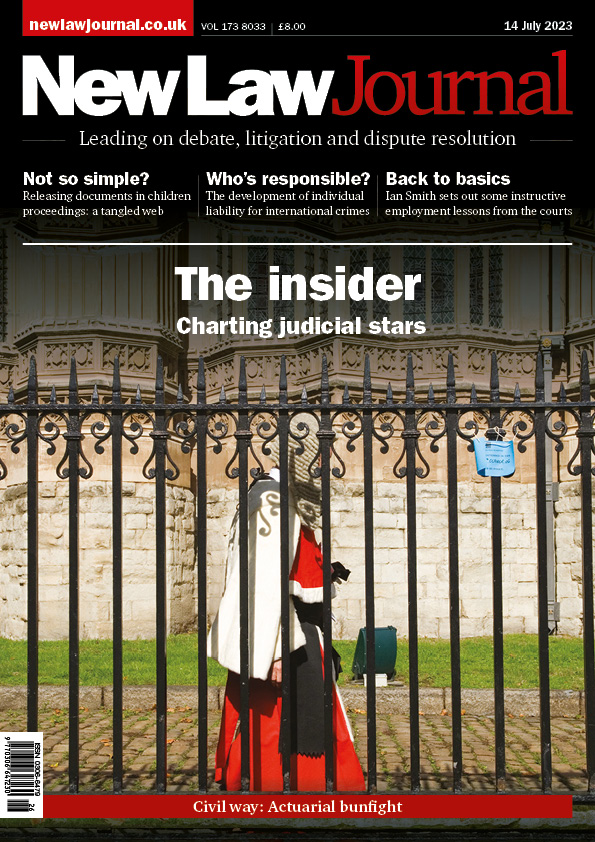

Which judges are tipped for the top jobs? In this week’s 'Insider', Professor Dominic Regan, of City Law School, praises Dame Sue Carr, the next Chief Justice, and reveals how her career could have taken an alternative albeit still high-profile trajectory!
Rules should be ‘simple and simply expressed’, according to the Courts Act 2003—yet Mr Justice Mostyn recently urged rule-makers to look again at the ‘Byzantine’ rules governing the release of documents to children proceedings.
The rise of legal consultants has been a game-changer for lawyers who want to work independently, manage their own caseload, and reduce the burdens of self-employment. In this week’s NLJ, Adrian Jaggard, CEO at AllC Group & Taylor Rose MW, looks ahead to the expansion of this model of working—research suggests one third of lawyers will work this way by 2026—and offers advice on how to prepare now for the changes to come.
The Nuremberg trials laid the groundwork for personal international criminal liability, and the process by which Vladimir Putin may one day be held responsible. In this week’s NLJ, Simon Parsons, associate lecturer at Bath Spa University, looks at the lack of individual liability for international crime before 1945.

As the courts gear up for the Long Vacation, Dominic Regan charts judicial stars on the rise & recommends a handy surgical procedure for costs lawyers
Back to school already? Ian Smith sets out some instructive lessons from the courts on the definition of a worker, the conduct of disciplinary hearings, & the perils of making a mistake
A Byzantine set of rules governs the release of documents in children proceedings: David Burrows calls for some sorely-needed simplicity
The courts in the Cayman Islands have shown a willingness to explore the link between insolvency & trust law in resolving novel issues: Christopher Levers & Jordan Constable analyse a recent example
In the first of a two-part series, Simon Parsons charts the development of individual liability for international crimes
Service without a seal; reducing tax penalties; no jokes: the Glancing blow; coughing impecuniosity; actuarial bunfight; chancery talk.

MOVERS & SHAKERS

Bellevue Law—Lianne Craig
Workplace law firm expands commercial disputes team with senior consultant hire

EIP—Rob Barker
IP firm promotes patent attorney to partner

Muckle LLP—Ryan Butler
Banking and restructuring team bolstered by insolvency specialist
NEWS
The Supreme Court has delivered a decisive ruling on termination under the JCT Design & Build form. Writing in NLJ this week, Andrew Singer KC and Jonathan Ward, of Kings Chambers, analyse Providence Building Services v Hexagon Housing Association [2026] UKSC 1, which restores the first-instance decision and curbs contractors’ termination rights for repeated late payment
Secondments, disciplinary procedures and appeal chaos all feature in a quartet of recent rulings. Writing in NLJ this week, Ian Smith, barrister and emeritus professor of employment law at UEA, examines how established principles are being tested in modern disputes
The AI revolution is no longer a distant murmur—it’s at the client’s desk. Writing in NLJ this week, Peter Ambrose, CEO of The Partnership and Legalito, warns that the ‘AI chickens’ have ‘come home to roost’, transforming not just legal practice but the lawyer–client relationship itself
A High Court ruling involving the Longleat estate has exposed the fault line between modern family building and historic trust drafting. Writing in NLJ this week, Charlotte Coyle, director and family law expert at Freeths, examines Cator v Thynn [2026] EWHC 209 (Ch), where trustees sought approval to modernise trusts that retain pre-1970 definitions of ‘child’, ‘grandchild’ and ‘issue’
Fresh proposals to criminalise ‘nudification’ apps, prioritise cyberflashing and non-consensual intimate images, and even ban under-16s from social media have reignited debate over whether the Online Safety Act 2023 (OSA 2023) is fit for purpose. Writing in NLJ this week, Alexander Brown, head of technology, media and telecommunications, and Alexandra Webster, managing associate, Simmons & Simmons, caution against reactive law-making that could undermine the Act’s ‘risk-based and outcomes-focused’ design
Copyright © 2026 LexisNexis

