

THIS ISSUE
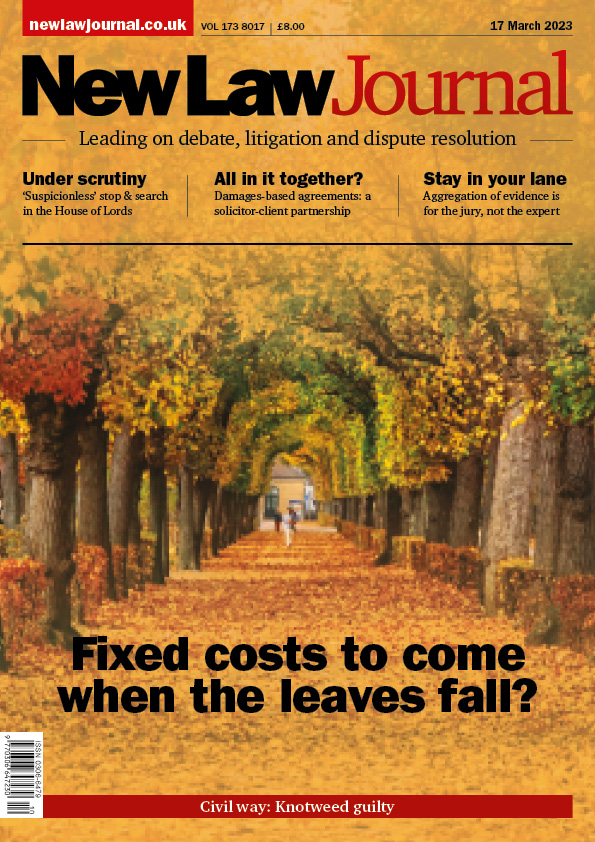

Damages-based agreements (DBAs) are the seldom-used option when it comes to ‘no win no fee’ cases, but is their lack of popularity justified? In this week’s NLJ, solicitor and DBA-proponent Richard Spector, partner at Spector Constant and Williams shares his personal experience of running DBA cases.
The extension of fixed recoverable costs is coming, despite some speculation that the project was being abandoned, Professor Dominic Regan of City Law School reveals in this week’s NLJ column, 'The Insider'.
Experts are advised not to amalgamate or exaggerate, when giving evidence, in an expert witness special in this week’s NLJ.
Nicholas Dobson dissects the nuisance case that hit the headlines and shocked art aficionados, Fearn v Tate Gallery Trustees, in this week’s NLJ.
‘Suspicionless’ stop and search is one of many controversial provisions in the Public Order Bill. Public and media attention has also focused on its restrictions on protest. Writing in this week’s NLJ, Neil Parpworth, of Leicester De Montfort Law School, looks in more detail at clauses 10 and 11, which sought to extend the powers of stop and search.

Fixed costs to come when the leaves fall? Dominic Regan tackles listing woes, distressed litigation funders & what’s spooking the banks
Vijay Ganapathy reflects on the pros and cons of QOCS reform, and highlights developments in the courts on whiplash claims and unsafe exposure
Neil Parpworth reports on the scrutiny of the Public Order Bill—and its proposed new powers for stop & search—in the House of Lords
Rooms with a view: Nicholas Dobson charts the long journey from the High Court to the Supreme Court and back again for Fearn v Tate Gallery Trustees
With the revocation of remaining EU legislation on the horizon, Fred Philpott highlights the challenges & opportunities for consumer credit law

MOVERS & SHAKERS

Bellevue Law—Lianne Craig
Workplace law firm expands commercial disputes team with senior consultant hire

EIP—Rob Barker
IP firm promotes patent attorney to partner

Muckle LLP—Ryan Butler
Banking and restructuring team bolstered by insolvency specialist
NEWS
The Supreme Court has delivered a decisive ruling on termination under the JCT Design & Build form. Writing in NLJ this week, Andrew Singer KC and Jonathan Ward, of Kings Chambers, analyse Providence Building Services v Hexagon Housing Association [2026] UKSC 1, which restores the first-instance decision and curbs contractors’ termination rights for repeated late payment
Secondments, disciplinary procedures and appeal chaos all feature in a quartet of recent rulings. Writing in NLJ this week, Ian Smith, barrister and emeritus professor of employment law at UEA, examines how established principles are being tested in modern disputes
The AI revolution is no longer a distant murmur—it’s at the client’s desk. Writing in NLJ this week, Peter Ambrose, CEO of The Partnership and Legalito, warns that the ‘AI chickens’ have ‘come home to roost’, transforming not just legal practice but the lawyer–client relationship itself
A High Court ruling involving the Longleat estate has exposed the fault line between modern family building and historic trust drafting. Writing in NLJ this week, Charlotte Coyle, director and family law expert at Freeths, examines Cator v Thynn [2026] EWHC 209 (Ch), where trustees sought approval to modernise trusts that retain pre-1970 definitions of ‘child’, ‘grandchild’ and ‘issue’
Fresh proposals to criminalise ‘nudification’ apps, prioritise cyberflashing and non-consensual intimate images, and even ban under-16s from social media have reignited debate over whether the Online Safety Act 2023 (OSA 2023) is fit for purpose. Writing in NLJ this week, Alexander Brown, head of technology, media and telecommunications, and Alexandra Webster, managing associate, Simmons & Simmons, caution against reactive law-making that could undermine the Act’s ‘risk-based and outcomes-focused’ design
Copyright © 2026 LexisNexis

