
header-logo header-logo

THIS ISSUE
Card image

Issue: Vol 170, Issue 7872

31 January 2020
IN THIS ISSUE
Law firms should embrace technology, flexible hours and remote working to break down barriers in the legal profession, the President of the London Solicitors Litigation Association (LSLA) has said

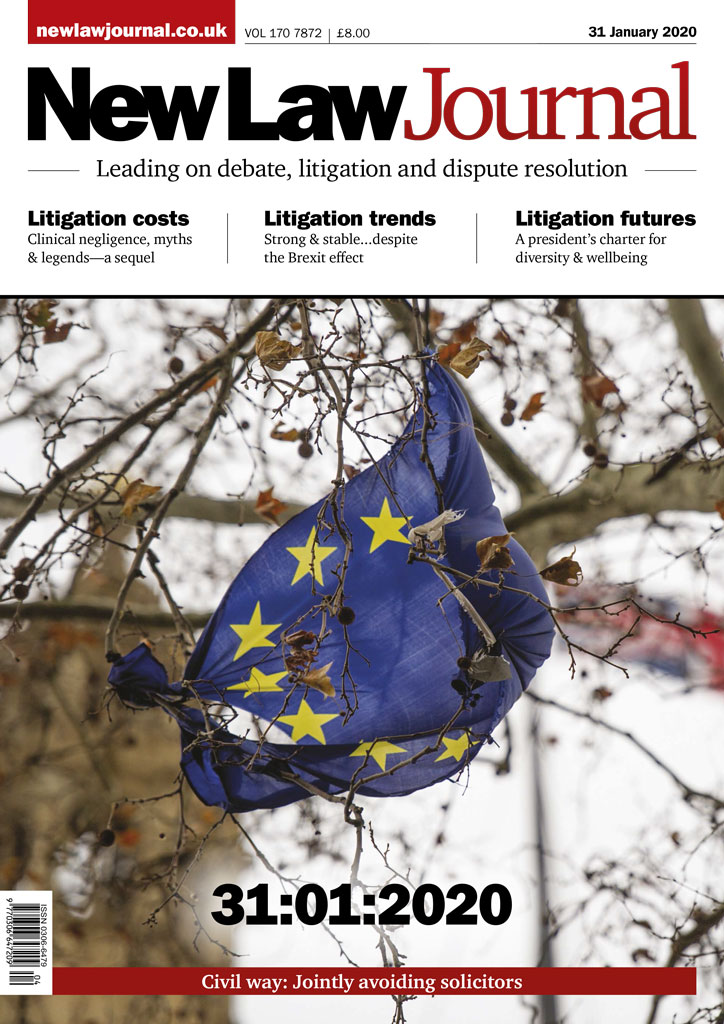
The UK’s position as a primary global legal centre is not going to change with Brexit, but there are some short-term challenges that we should be braced to address, says David Greene

The LSLA’s ‘Brexit’ President, Julian Acratopulo, signs off with the hope that the profession continues to work towards establishing a modern, diverse & inclusive profession

Brice Dickson outlines the Supreme Court highlights for 2019

While Brexit has created unhelpful uncertainty for litigators & their clients, statistics suggest that international cases in London are on the rise & that the capital remains a primary global legal centre. But what about the future & wellbeing of the next generation of litigators & what should law firms be doing to ensure their teams are both diverse & inclusive? Grania Langdon-Down reports

Geoffrey Bindman QC highlights William Garrow’s unquestionable impact on criminal trials

The argument about legal costs in clinical negligence & personal injury litigation shows no sign of abating, says David Locke

The Council for Licensed Conveyancers (CLC) has launched a discussion paper, ‘Conveyancing 2030’, predicting huge change ahead as the administrative side of the role becomes automated
Law firms are failing to support their disabled employees, a major report has found
Progress on judicial diversity has been slow, according to a JUSTICE working party report published this month
Show
10
Results
Results
10
Results

MOVERS & SHAKERS

Bellevue Law—Lianne Craig

Bellevue Law—Lianne Craig

Workplace law firm expands commercial disputes team with senior consultant hire

EIP—Rob Barker

EIP—Rob Barker

IP firm promotes patent attorney to partner

Muckle LLP—Ryan Butler

Muckle LLP—Ryan Butler

Banking and restructuring team bolstered by insolvency specialist

NEWS
A High Court ruling involving the Longleat estate has exposed the fault line between modern family building and historic trust drafting. Writing in NLJ this week, Charlotte Coyle, director and family law expert at Freeths, examines Cator v Thynn [2026] EWHC 209 (Ch), where trustees sought approval to modernise trusts that retain pre-1970 definitions of ‘child’, ‘grandchild’ and ‘issue’
Fresh proposals to criminalise ‘nudification’ apps, prioritise cyberflashing and non-consensual intimate images, and even ban under-16s from social media have reignited debate over whether the Online Safety Act 2023 (OSA 2023) is fit for purpose. Writing in NLJ this week, Alexander Brown, head of technology, media and telecommunications, and Alexandra Webster, managing associate, Simmons & Simmons, caution against reactive law-making that could undermine the Act’s ‘risk-based and outcomes-focused’ design
Recent allegations surrounding Peter Mandelson and Andrew Mountbatten-Windsor have reignited scrutiny of the ancient common law offence of misconduct in public office. Writing in NLJ this week, Simon Parsons, teaching fellow at Bath Spa University, asks whether their conduct could clear a notoriously high legal hurdle
A landmark ruling has reshaped child clinical negligence claims. Writing in NLJ this week, Jodi Newton, head of birth and paediatric negligence at Osbornes Law, explains how the Supreme Court in CCC v Sheffield Teaching Hospitals NHS Foundation Trust [2026] UKSC 5 has overturned Croke v Wiseman, ending the long-standing bar on children recovering ‘lost years’ earnings
A Court of Appeal ruling has drawn a firm line under party autonomy in arbitration. Writing in NLJ this week, Masood Ahmed, associate professor at the University of Leicester, analyses Gluck v Endzweig [2026] EWCA Civ 145, where a clause allowing arbitrators to amend an award ‘at any time’ was held incompatible with the Arbitration Act 1996
back-to-top-scroll