
header-logo header-logo

06 June 2013 / Helen Pugh
Categories: Features , Personal injury
printer mail-detail

When adventures go wrong

istock_000024183700medium

Helen Pugh examines the courts’ differing approaches to accidents arising out of risky activities

"Adults who choose to engage in physical activities which obviously give rise to a degree of unavoidable risk may find that they have no means of recompense if the risk materialises so that they are injured” (per May LJ in Poppleton v Trustees of the Portsmouth Youth Activities Committee [2008] All ER (D) 150 (Jun) (CA)).

Just how sweepingly is this sweeping statement likely to be applied? The answer seems to be: not very, in light of the ruling in Wilson v Clyne Farm Centre [2013] EWHC 229 (QB) (Swift J).

Wilson v Clyne Farm Centre

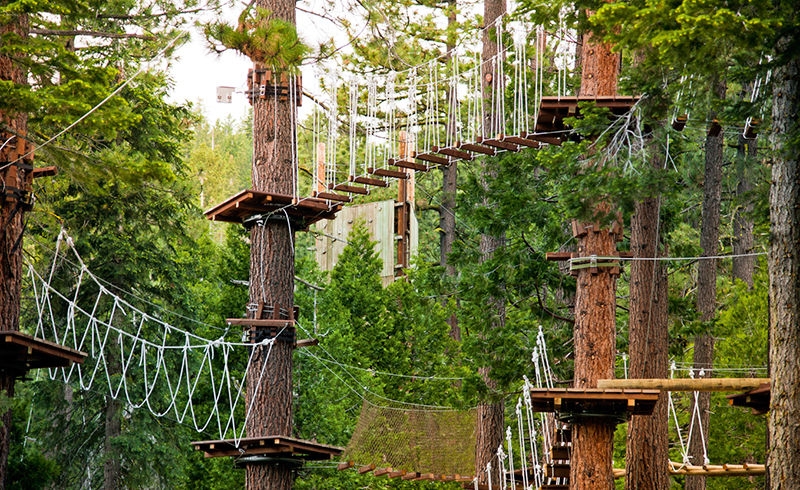
Clyne Farm Centre is an outdoor activity centre. One of the activities on offer is a cross country assault course which included a challenge called the Burma Bridge. This challenge had three stages:

  1. a log climb up to a platform in a tree;
  2. a rope bridge suspended between that tree and a second tree; and
  3. a fireman’s pole descent from the platform
If you are not a subscriber, subscribe now to read this content
If you are already a subscriber sign in
...or Register for two weeks' free access to subscriber content

MOVERS & SHAKERS

Cripps—Radius Law

Cripps—Radius Law

Commercial and technology practice boosted by team hire

Switalskis—Grimsby

Switalskis—Grimsby

Firm expands with new Grimsby office to serve North East Lincolnshire

Slater Heelis—Will Newman & Lucy Spilsbury

Slater Heelis—Will Newman & Lucy Spilsbury

Property team boosted by two solicitor appointments

NEWS
The Supreme Court has delivered a decisive ruling on termination under the JCT Design & Build form. Writing in NLJ this week, Andrew Singer KC and Jonathan Ward, of Kings Chambers, analyse Providence Building Services v Hexagon Housing Association [2026] UKSC 1, which restores the first-instance decision and curbs contractors’ termination rights for repeated late payment
Secondments, disciplinary procedures and appeal chaos all feature in a quartet of recent rulings. Writing in NLJ this week, Ian Smith, barrister and emeritus professor of employment law at UEA, examines how established principles are being tested in modern disputes
The AI revolution is no longer a distant murmur—it’s at the client’s desk. Writing in NLJ this week, Peter Ambrose, CEO of The Partnership and Legalito, warns that the ‘AI chickens’ have ‘come home to roost’, transforming not just legal practice but the lawyer–client relationship itself
A High Court ruling involving the Longleat estate has exposed the fault line between modern family building and historic trust drafting. Writing in NLJ this week, Charlotte Coyle, director and family law expert at Freeths, examines Cator v Thynn [2026] EWHC 209 (Ch), where trustees sought approval to modernise trusts that retain pre-1970 definitions of ‘child’, ‘grandchild’ and ‘issue’
Fresh proposals to criminalise ‘nudification’ apps, prioritise cyberflashing and non-consensual intimate images, and even ban under-16s from social media have reignited debate over whether the Online Safety Act 2023 (OSA 2023) is fit for purpose. Writing in NLJ this week, Alexander Brown, head of technology, media and telecommunications, and Alexandra Webster, managing associate, Simmons & Simmons, caution against reactive law-making that could undermine the Act’s ‘risk-based and outcomes-focused’ design
back-to-top-scroll
