
header-logo header-logo

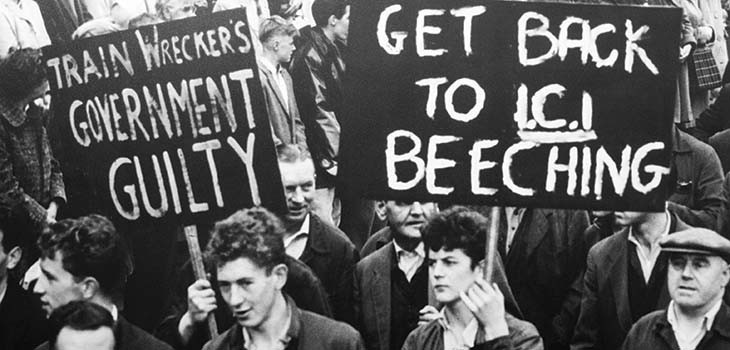
Reflections on Beeching: beware the axeman

10 February 2023 / William Gibson
Issue: 8012 / Categories: Features , Public
printer mail-detail
110007
Did Richard Beeching deserve the public vitriol he attracted for the closure of the railways? William Gibson examines the impact of the swingeing 1960s cuts

What do the Transport Act 1962 (effective January 1963) and the Courts Act 1971 have in common? Two things: they were both intended to make improvements by cutting, and the axeman in each case was Richard Beeching.

Beeching in charge

A scientist employed by Imperial Chemical Industries (ICI), he was seconded to the Civil Service for five years from June 1961 to be first chairman of the newly created British Railways Board, following abolition of the British Transport Commission (BTC). His proposed employment was disclosed to Parliament in March 1961 by the Minister of Transport, Ernest Marples. The announcement that he was to be paid a salary of £24,000 (about £470,000 today), which was more than twice as much as the outgoing chairman of the BTC, sparked an angry and extensive debate in the House. Labour opposition members en masse condemned his lack of knowledge

If you are not a subscriber, subscribe now to read this content
If you are already a subscriber sign in
...or Register for two weeks' free access to subscriber content

MOVERS & SHAKERS

Freeths—Ruth Clare

Freeths—Ruth Clare

National real estate team bolstered by partner hire in Manchester

Farrer & Co—Claire Gordon

Farrer & Co—Claire Gordon

Partner appointed head of family team

mfg Solicitors—Neil Harrison

mfg Solicitors—Neil Harrison

Firm strengthens agriculture and rural affairs team with partner return

NEWS
Conveyancing lawyers have enjoyed a rapid win after campaigning against UK Finance’s decision to charge for access to the Mortgage Lenders’ Handbook
The Crown Prosecution Service (CPS) has launched a recruitment drive for talented early career and more senior barristers and solicitors
Regulators differed in the clarity and consistency of their post-Mazur advice and guidance, according to an interim report by the Legal Services Board (LSB)
The Solicitors Act 1974 may still underpin legal regulation, but its age is increasingly showing. Writing in NLJ this week, Victoria Morrison-Hughes of the Association of Costs Lawyers argues that the Act is ‘out of step with modern consumer law’ and actively deters fairness
A Competition Appeal Tribunal (CAT) ruling has reopened debate on the availability of ‘user damages’ in competition claims. Writing in NLJ this week, Edward Nyman of Hausfeld explains how the CAT allowed Dr Liza Lovdahl Gormsen’s alternative damages case against Meta to proceed, rejecting arguments that such damages are barred in competition law
back-to-top-scroll
