
header-logo header-logo

NLJ this week: Assisted dying under the legal microscope

16 January 2026
Issue: 8145 / Categories: Legal News , Health , Human rights , Wills & Probate , Criminal
printer mail-detail
240110
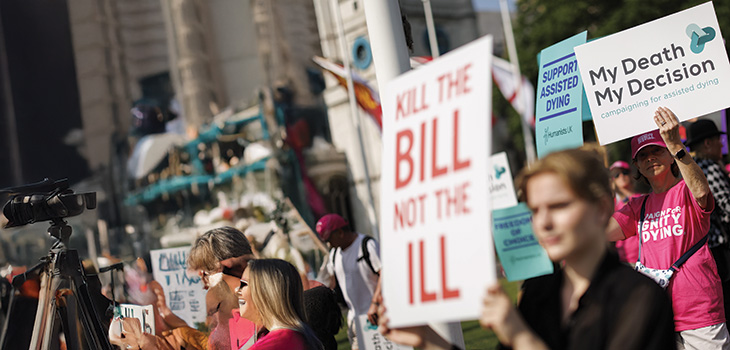
Assisted dying remains one of the most fraught fault lines in English law, where compassion and criminal liability sit uncomfortably close. Writing in NLJ this week, Julie Gowland and Barny Croft of Birketts examine how acts motivated by care—booking travel, completing paperwork, or offering emotional support—can still fall within the wide reach of the Suicide Act 1961

The article explains why prosecutions are rare but real, guided by DPP policy rather than immunity, and why inquests are increasingly the first legal reckoning for families and advisers alike. The civil consequences are just as stark: under the forfeiture rule, those who assist may lose inheritance rights unless courts exercise discretion.

Against this backdrop, the authors assess the Terminally Ill Adults (End of Life) Bill, now before the Lords, questioning whether its safeguards and reliance on medical judgement truly reflect modern medical reality. Until reform arrives, practitioners must navigate a regime that criminalises conduct many see as humane.

RELATED ARTICLES

MOVERS & SHAKERS

Freeths—Ruth Clare

Freeths—Ruth Clare

National real estate team bolstered by partner hire in Manchester

Farrer & Co—Claire Gordon

Farrer & Co—Claire Gordon

Partner appointed head of family team

mfg Solicitors—Neil Harrison

mfg Solicitors—Neil Harrison

Firm strengthens agriculture and rural affairs team with partner return

NEWS
Conveyancing lawyers have enjoyed a rapid win after campaigning against UK Finance’s decision to charge for access to the Mortgage Lenders’ Handbook
The Crown Prosecution Service (CPS) has launched a recruitment drive for talented early career and more senior barristers and solicitors
Regulators differed in the clarity and consistency of their post-Mazur advice and guidance, according to an interim report by the Legal Services Board (LSB)
The dangers of uncritical artificial intelligence (AI) use in legal practice are no longer hypothetical. In this week's NLJ, Dr Charanjit Singh of Holborn Chambers examines cases where lawyers relied on ‘hallucinated’ citations — entirely fictitious authorities generated by AI tools
The Solicitors Act 1974 may still underpin legal regulation, but its age is increasingly showing. Writing in NLJ this week, Victoria Morrison-Hughes of the Association of Costs Lawyers argues that the Act is ‘out of step with modern consumer law’ and actively deters fairness
back-to-top-scroll
