
header-logo header-logo

29 October 2021
Issue: 7954 / Categories: Legal News , Profession , Pro Bono
printer mail-detail

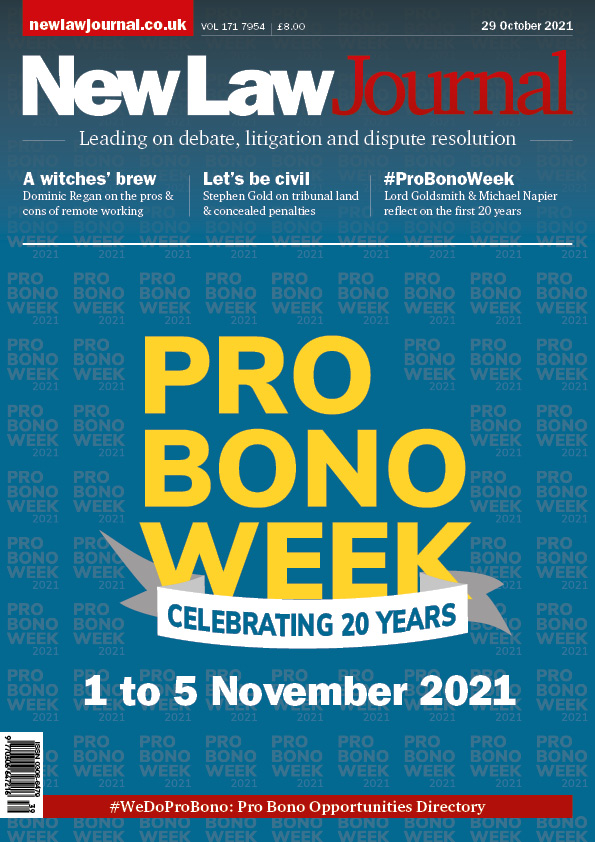
NLJ Pro Bono Week edition celebrates two decades

Lawyers up and down the country are preparing for the 20th anniversary Pro Bono Week (1-5 November)

This year’s event looks ahead to the next two decades as well as spotlighting key cases from the past.

Toby Brown, chair of the Pro Bono Week organising committee, said: ‘Last year’s Pro Bono Week saw 50 online events involving 5,000 lawyers, students and members of the charity sector discuss the challenges, and best practice, in providing pro bono during a pandemic.

‘This year, we are looking forward to taking stock at both in person and online events and discussing how in the coming years we can continue to encourage and support the profession’s pro bono efforts.’

There is something for everyone, from students to late career pro bono, and from practical tips for law clinic volunteers to advice on forming partnerships between law firms and in-house clients, as well as a Pro Bono Opportunities Directory (attached). While climate action features strongly on the agenda, there is also an event on vicarious trauma and self-care, and a contract negotiation workshop for small charities (see http://probonoweek.org.uk/events).

The launch event will take place in person and online, and will host a panel of speakers including the Attorney General, exploring the past, present and future of pro bono. Other highlights include a panel event on the rule of law and access to justice with Baroness Hale, Baroness Helena Kennedy QC, Law Society president I Stephanie Boyce and others. For a full list, see www.probonoweek.org.uk.

To set the mood and show our support, this week’s NLJ is a pro bono special edition. Features include an interview with Lord Goldsmith, former Attorney-General, and Irwin Mitchell partner Michael Napier, who both played key roles in the creation of Pro Bono Week. In a separate article, former leaders of the three main professional bodies, the Law Society, Bar Council and CILEX, look back at key moments in pro bono.

Elsewhere in the magazine (which if free to view here) judge and National Pro Bono Centre board member Sir Robin Knowles heralds the versatility and dedication of lawyers to pro bono, which can be fun, for example, ‘zigzagging across remoter parts of Wales’ or dispensing advice from a double decker bus. 


Issue: 7954 / Categories: Legal News , Profession , Pro Bono
printer mail-details

MOVERS & SHAKERS

Cripps—Radius Law

Cripps—Radius Law

Commercial and technology practice boosted by team hire

Switalskis—Grimsby

Switalskis—Grimsby

Firm expands with new Grimsby office to serve North East Lincolnshire

Slater Heelis—Will Newman & Lucy Spilsbury

Slater Heelis—Will Newman & Lucy Spilsbury

Property team boosted by two solicitor appointments

NEWS
The Supreme Court has delivered a decisive ruling on termination under the JCT Design & Build form. Writing in NLJ this week, Andrew Singer KC and Jonathan Ward, of Kings Chambers, analyse Providence Building Services v Hexagon Housing Association [2026] UKSC 1, which restores the first-instance decision and curbs contractors’ termination rights for repeated late payment
Secondments, disciplinary procedures and appeal chaos all feature in a quartet of recent rulings. Writing in NLJ this week, Ian Smith, barrister and emeritus professor of employment law at UEA, examines how established principles are being tested in modern disputes
The AI revolution is no longer a distant murmur—it’s at the client’s desk. Writing in NLJ this week, Peter Ambrose, CEO of The Partnership and Legalito, warns that the ‘AI chickens’ have ‘come home to roost’, transforming not just legal practice but the lawyer–client relationship itself
A High Court ruling involving the Longleat estate has exposed the fault line between modern family building and historic trust drafting. Writing in NLJ this week, Charlotte Coyle, director and family law expert at Freeths, examines Cator v Thynn [2026] EWHC 209 (Ch), where trustees sought approval to modernise trusts that retain pre-1970 definitions of ‘child’, ‘grandchild’ and ‘issue’
Fresh proposals to criminalise ‘nudification’ apps, prioritise cyberflashing and non-consensual intimate images, and even ban under-16s from social media have reignited debate over whether the Online Safety Act 2023 (OSA 2023) is fit for purpose. Writing in NLJ this week, Alexander Brown, head of technology, media and telecommunications, and Alexandra Webster, managing associate, Simmons & Simmons, caution against reactive law-making that could undermine the Act’s ‘risk-based and outcomes-focused’ design
back-to-top-scroll
