
header-logo header-logo

Insurance surgery: Getting serious

02 March 2016 / Duncan Rutter
Issue: 7689 / Categories: Features , Insurance surgery , Profession
printer mail-detail
001_nlj_7689_rutter

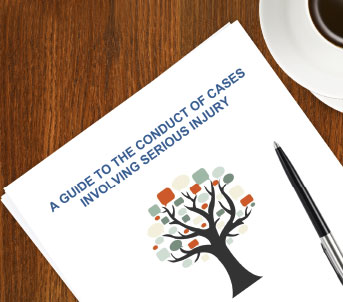
Duncan Rutter reviews The Serious Injury Guide

The Serious Injury Guide has taken over a year to finalise. It was developed in response to the pilot of the Multi Track Code (2008) which concluded in 2011. It is a voluntary guide that applies to high value claims. To date 13 insurers and 48 law firms have signed up to it. The full guide can be found here.

This is a best practice guide for complex injury claims with a full liability value of at least £250k. It does not apply to clinical negligence or asbestos-related disease claims and, emphasising the voluntary nature of the code, does not affect a solicitor’s duty to act in the best interests of his/her client.

Objectives

The guide begins with its objectives. It is intended that liability should be resolved as quickly as possible and in any event within six months of first notification, a period twice as long as that allowed by the pre-action protocol reflecting the importance of a more careful consideration of liability in

If you are not a subscriber, subscribe now to read this content
If you are already a subscriber sign in
...or Register for two weeks' free access to subscriber content

MOVERS & SHAKERS

Freeths—Ruth Clare

Freeths—Ruth Clare

National real estate team bolstered by partner hire in Manchester

Farrer & Co—Claire Gordon

Farrer & Co—Claire Gordon

Partner appointed head of family team

mfg Solicitors—Neil Harrison

mfg Solicitors—Neil Harrison

Firm strengthens agriculture and rural affairs team with partner return

NEWS
Conveyancing lawyers have enjoyed a rapid win after campaigning against UK Finance’s decision to charge for access to the Mortgage Lenders’ Handbook
The Crown Prosecution Service (CPS) has launched a recruitment drive for talented early career and more senior barristers and solicitors
Regulators differed in the clarity and consistency of their post-Mazur advice and guidance, according to an interim report by the Legal Services Board (LSB)
The dangers of uncritical artificial intelligence (AI) use in legal practice are no longer hypothetical. In this week's NLJ, Dr Charanjit Singh of Holborn Chambers examines cases where lawyers relied on ‘hallucinated’ citations — entirely fictitious authorities generated by AI tools
The Solicitors Act 1974 may still underpin legal regulation, but its age is increasingly showing. Writing in NLJ this week, Victoria Morrison-Hughes of the Association of Costs Lawyers argues that the Act is ‘out of step with modern consumer law’ and actively deters fairness
back-to-top-scroll
