


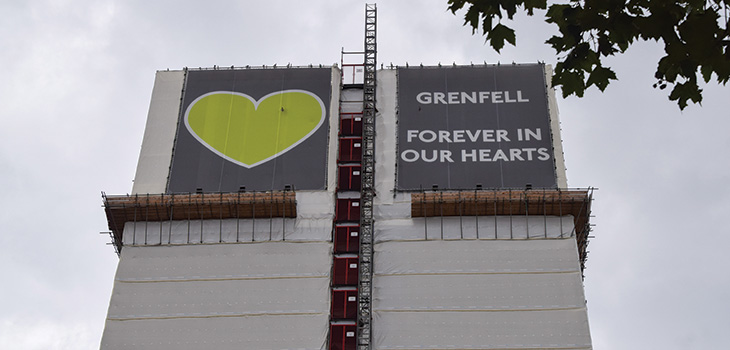
Retired Court of Appeal Judge Moore-Bick, who led the six-year public inquiry into the 14 June 2017 fire, said: ‘The simple truth is that the deaths that occurred were all avoidable.’
His report describes decades of failure by those responsible for the safety of residents at the 24-storey north Kensington tower block, which was built in 1974 and refurbished in 2016 with combustible products.
Moore-Bick’s attributed blame to ‘the government, the Tenant Management Organisation, the local council—Royal Borough of Kensington and Chelsea, those who manufactured and supplied the material used in the refurbishment, those who certified their suitability for use on a high-rise building, the architect, the principal contractor, and some of its sub-contractors particularly Harley Curtain Wall and its successor Harley Facades, some of the consultants in particular the fire engineer, the Local Authority Buildings Department and the London Fire Brigade.
‘Not all of them bear the same degree of responsibility for the eventual disaster, but as our reports show all contributed to it in one way or another,’ he said. ‘In most cases, through incompetence, but in some cases they were dishonest and driven by greed.’
Jules Carey, partner at Bindmans, which represents more than 200 of the core participants at the inquiry, said: ‘The long-held beliefs of the bereaved, survivors and residents of Grenfell Tower were cast as fact in the findings by the Chair of the Public Inquiry in his condemnatory report.
‘Incompetence, dishonesty and greed were found to be the causes of the completely avoidable deaths of 72 people, the destruction of 151 homes and the shattering of the community. Our clients welcome the conclusion of the inquiry and now call on the government to urgently implement all 58 recommendations made by Sir Martin Moore-Bick and on the Metropolitan Police and CPS to push on with their investigation and conclude their work with haste.’
Moore-Bick’s 1,700-page final report, published this week, sets out in detail the ‘systematic dishonesty’ of those who made and sold the cladding panels and insulation, which coated the tower in combustible materials. Those firms then ‘engaged in deliberate and sustained strategies to manipulate the testing processes, misrepresent test data and mislead the market’, he said.
He called out ‘deliberate and sustained’ manipulation of fire-safety testing, misrepresentation of test data and misleading of the market.
Arconic Architectural Products, which manufactured and sold the panels used in the external wall of Grenfell Tower, from 2005 until after the fire, ‘deliberately concealed from the market the true extent of the danger of using Reynobond 55 PE in cassette form, particularly on high-rise buildings’, he said. The panels had a polyethylene core, which ‘burns fiercely’ and was ‘extremely dangerous’ in this form.



