
header-logo header-logo

22 June 2018 / Sir Geoffrey Bindman KC
Issue: 7798 / Categories: Features , Profession
printer mail-detail

Matrimonial intrigue

nlj_7798_bindman

Geoffrey Bindman QC unravels the curious case of the Duchess of Kingston

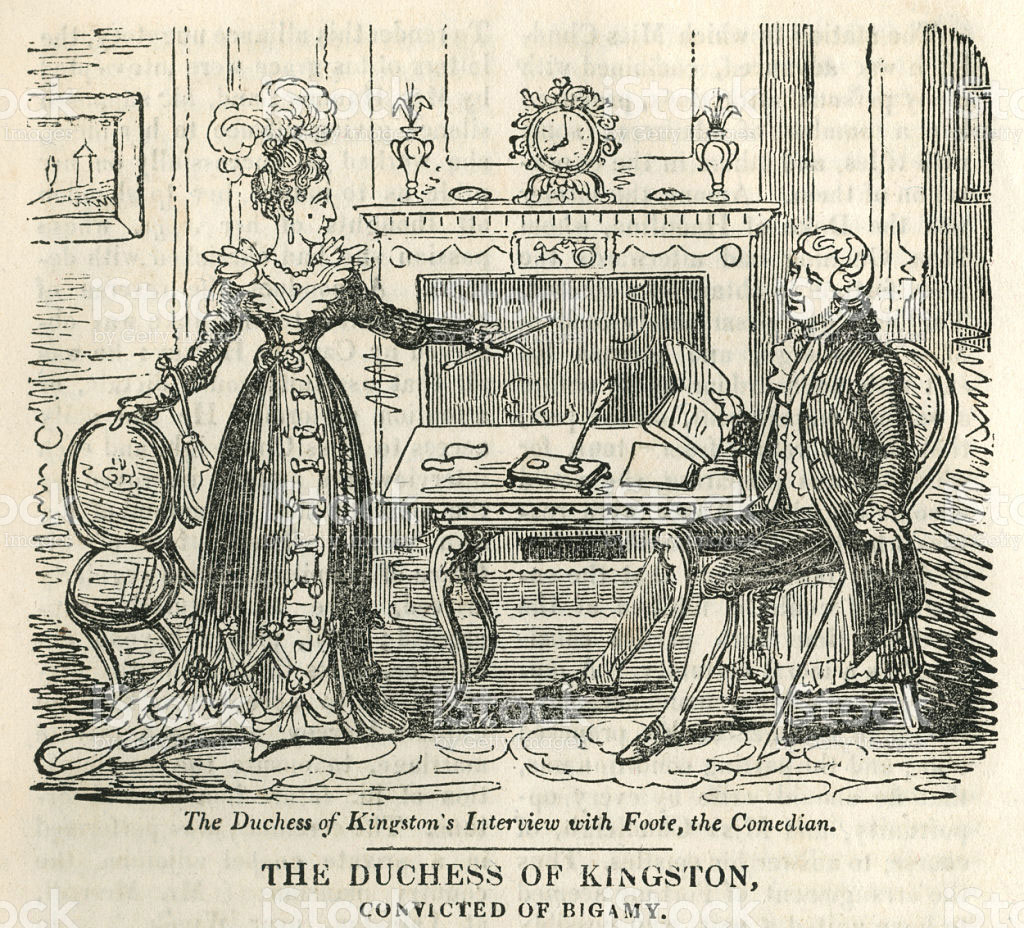
Elizabeth Chudleigh was the Christine Keeler of the 18th century, though rather more successful in her chosen way of life. By force of personality and physical attraction, she rose from a modest background to prominence in the court of King George III, marrying the heir to an earl and later the Duke of Kingston. She is best remembered today, however, for being convicted of bigamy by the House of Lords in 1786.

A secret marriage

Her story throws some light on the law relating to marriage and the status of women in those days. She secured a salaried position in the court as maid of honour to the Princess of Wales. Born in 1720, she met and in 1744 married Augustus Hervey, a naval officer who later inherited the title of Earl of Bristol. The marriage ceremony was performed in a private chapel at the home of her aunt and kept secret in order to enable her to keep her job,

If you are not a subscriber, subscribe now to read this content
If you are already a subscriber sign in
...or Register for two weeks' free access to subscriber content

MOVERS & SHAKERS

Cripps—Radius Law

Cripps—Radius Law

Commercial and technology practice boosted by team hire

Switalskis—Grimsby

Switalskis—Grimsby

Firm expands with new Grimsby office to serve North East Lincolnshire

Slater Heelis—Will Newman & Lucy Spilsbury

Slater Heelis—Will Newman & Lucy Spilsbury

Property team boosted by two solicitor appointments

NEWS
A High Court ruling involving the Longleat estate has exposed the fault line between modern family building and historic trust drafting. Writing in NLJ this week, Charlotte Coyle, director and family law expert at Freeths, examines Cator v Thynn [2026] EWHC 209 (Ch), where trustees sought approval to modernise trusts that retain pre-1970 definitions of ‘child’, ‘grandchild’ and ‘issue’
Fresh proposals to criminalise ‘nudification’ apps, prioritise cyberflashing and non-consensual intimate images, and even ban under-16s from social media have reignited debate over whether the Online Safety Act 2023 (OSA 2023) is fit for purpose. Writing in NLJ this week, Alexander Brown, head of technology, media and telecommunications, and Alexandra Webster, managing associate, Simmons & Simmons, caution against reactive law-making that could undermine the Act’s ‘risk-based and outcomes-focused’ design
Recent allegations surrounding Peter Mandelson and Andrew Mountbatten-Windsor have reignited scrutiny of the ancient common law offence of misconduct in public office. Writing in NLJ this week, Simon Parsons, teaching fellow at Bath Spa University, asks whether their conduct could clear a notoriously high legal hurdle
A landmark ruling has reshaped child clinical negligence claims. Writing in NLJ this week, Jodi Newton, head of birth and paediatric negligence at Osbornes Law, explains how the Supreme Court in CCC v Sheffield Teaching Hospitals NHS Foundation Trust [2026] UKSC 5 has overturned Croke v Wiseman, ending the long-standing bar on children recovering ‘lost years’ earnings
A Court of Appeal ruling has drawn a firm line under party autonomy in arbitration. Writing in NLJ this week, Masood Ahmed, associate professor at the University of Leicester, analyses Gluck v Endzweig [2026] EWCA Civ 145, where a clause allowing arbitrators to amend an award ‘at any time’ was held incompatible with the Arbitration Act 1996
back-to-top-scroll
