


- Human Rights Act 1998—24 years on.
- ‘Never-ending conflict between competing rights’.
- A look at the recent cases against the Met and the BBC in which human rights were in issue.
Nearly a quarter century after the enactment of the Human Rights Act 1998, the criminal courts continue to occupy the frontline in the never-ending conflict between competing rights under the European Convention on Human Rights (ECHR). The dilemmas only increase when those battles are fought against a backdrop of major public policy considerations such as national security, public health and the scourge of male violence against women—including where the perpetrator exploits a position of power and authority.
Leigh v Metropolitan Police Commissioner [2022] EWHC 527 (Admin), [2022] All ER (D) 57 (Mar)
This case arose from the awful events of Wednesday 3 March 2021 when Sarah Everard went missing while walking home from Clapham to Brixton Hill in South London. Six days later, on 9 March 2021, the Metropolitan Police announced that a serving Met officer, Wayne Couzens, had been arrested on suspicion of kidnap. The next day, Sarah’s remains were found. Couzens was charged and later pleaded guilty to kidnap, rape and murder. The evidence against him included harrowing CCTV footage of the moment when he coerced his victim into his vehicle by brandishing his police warrant card. He received a whole life sentence and will die in prison.
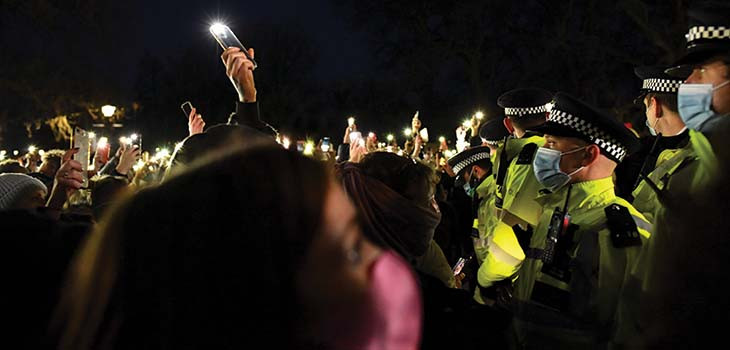
This judgment relates to the efforts, in the week after Sarah’s disappearance, to organise a vigil in her memory. A collective called #ReclaimTheseStreets wished to hold the event on Clapham Common on Saturday 13 March. However, the Coronavirus regulations then in force restricted outdoor gatherings of more than 30 people in so-called Tier 4 areas, made it an offence to breach that prohibition without reasonable excuse and gave the police power to arrest anyone they reasonably suspected of committing such an offence or, alternatively, to serve a Fixed Penalty Notice (FPN) imposing a fine of up to £10,000. In the end, though, #ReclaimTheseStreets abandoned their plans, blaming the cancellation on a succession of decisions by the Metropolitan Police, each of which, they argued, was based on an erroneous interpretation of the regulations. Specifically, it was said, the police were wrong to assume that organising or attending the vigil would automatically amount to a criminal offence under the Health Protection (Coronavirus, Restrictions) (All Tiers) (England) Regulations 2020 and had ignored the possibility that a reasonable excuse might have been provided by the rights to freedom of expression and peaceful assembly under Articles 10 and 11 of the European Convention on Human Rights.
It is worth emphasising that the event which did take place that day on Clapham Common, in the course of which the police controversially made a number of arrests, was not the same as the one planned but ultimately abandoned by #ReclaimTheseStreets.
In handing down judgment on the judicial review application brought against the then Metropolitan Police Commissioner, Dame Cressida Dick, the Divisional Court reasoned as follows. Organising and attending the planned vigil would not have been criminal if that had involved the lawful exercise of Convention rights. Since the burden of proving that a defendant had no reasonable excuse lay on the prosecution, a consideration of whether that burden could be discharged was fundamental to the lawfulness of any decision to prosecute or to issue a Fixed Penalty Notice under the regulations. The same was true of the police’s lesser enforcement powers. The police had been under a duty to carry out a proportionality assessment, weighing up the gravity of the public health risks compared with these fundamental Convention rights. What the police could not do was simply ignore the current state of the evidence in relation to the risks to public health and just assume that any such gathering would pose a serious risk. Each of the Met’s decisions relating to the planned event had had a ‘chilling effect’ and contributed to the eventual decision to cancel.
The claim was allowed and the Divisional Court granted a declaration that each of the police decisions under review was unlawful but declined to award damages, holding that the declaratory relief was a sufficient vindication of the claimants’ rights.
Of course, difficult choices as between competing human rights, often arising in strikingly similar circumstances, are by no means confined to the criminal jurisdiction.
Her Majesty’s Attorney General for England and Wales v British Broadcasting Corp [2022] EWHC 826 (QB), [2022] All ER (D) 41 (Apr)
This case was also decided against the background of the ongoing debate about society’s attitude to misogyny, sexist violence and coercive control. The Attorney applied for an injunction, stopping the broadcast of a programme about a man (referred to only as ‘X’), who was said to have exploited his position as an informant to MI5 in order to carry out a campaign of physical and psychological abuse against two different female partners.
Chamberlain J held that, if it wished to pray in aid the law of confidentiality, the Government, just like any other litigant, had to prove all the elements of that cause of action and then satisfy the court that the balance of the public interests came down in favour of the grant of injunctive relief.
Ultimately, however, His Lordship was persuaded that if the broadcast went ahead, there would be a real and immediate danger that X would be killed or seriously injured and the national security of the UK would be put at risk. Even assuming an individual’s rights to life and not to be subjected to torture (ECHR Arts 2 & 3) had to be weighed against other Convention rights, including the right to freedom of expression, the balance came down in favour of granting the injunction.
David Walbank QC is a member of Red Lion Chambers and the founder of the updating website www.crimecast.law on which he presents video case reviews of recent judgments. The site currently hosts more than 200 free-to-view videos.



